殴
Character Story & Explanation
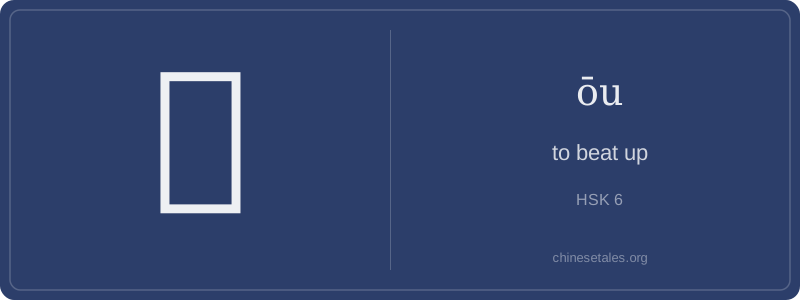
The earliest form of 殴 appears in Warring States bamboo slips as a compound pictograph: on the left, a hand holding a weapon (殳 — a ceremonial halberd-like staff), and on the right, 乚 (a bent shape suggesting a crouching or falling person). Oracle bone inscriptions don’t contain 殴, but by the Qin dynasty, the structure stabilized: 殳 (shū) radical on the left — unmistakably depicting a hand gripping a long pole with a curved blade — fused with 区 (qū), originally a phonetic component but visually evoking confinement or containment, perhaps hinting at the victim being cornered or subdued. The eight strokes crystallized into today’s balanced yet tense form: three for 殳’s ‘hand + weapon’ motif, five for 区’s enclosed curve and dot.
By the Han dynasty, 殴 had shed any ritual or symbolic connotation and settled firmly into its modern meaning of ‘violent physical assault’. The Shuōwén Jiězì (121 CE) defines it as ‘擊也’ (jī yě, ‘to strike’), but classical usage already implied severity — Sima Qian’s Records of the Grand Historian uses 殴 in accounts of prison abuse and official brutality. Its visual logic remains striking: the left side (殳) is literally ‘the tool of hitting’, and the right (区) subtly suggests ‘a confined space where the blow lands’ — no wonder it never means ‘to pat’ or ‘to tap’.
At its core, 殴 isn’t just ‘to beat up’ — it’s the visceral, intentional act of striking with a weapon or bare hands, carrying weight, anger, and often illegality. Unlike generic verbs like 打 (dǎ, ‘to hit’), 殴 implies aggression, force, and frequently criminal violence: think street brawls, police brutality reports, or courtroom testimony. It’s rarely used in casual speech — you’d never say ‘I 殴 my friend’ playfully — and almost never appears in positive or neutral contexts.
Grammatically, 殴 is almost always transitive and formal, appearing in written registers: news headlines (殴打路人), legal documents (涉嫌殴打他人), or literary narration. It’s commonly paired with 打 as 殴打 (ōu dǎ), which reinforces the violent action but softens the tone slightly — though still firmly in the realm of assault. Learners often mistakenly use 殴 where 打 suffices (e.g., *他殴了我一下 → incorrect; he ‘tapped’ me — use 打), or confuse it with passive constructions (it’s never used reflexively or without an object).
Culturally, 殴 carries judicial gravity: in China’s Criminal Law, 第二百三十四条 (Article 234) defines 故意伤害罪 — ‘intentional injury’, where 殴 is the operative verb in key phrases like 殴致轻伤 (ōu zhì qīngshāng, ‘assault resulting in minor injury’). This legal resonance makes it a high-stakes character — one that signals seriousness, not slapstick. A common learner trap? Overusing it after watching martial arts films — remember: 殴 is courtroom language, not kung fu dialogue.