氧
Character Story & Explanation
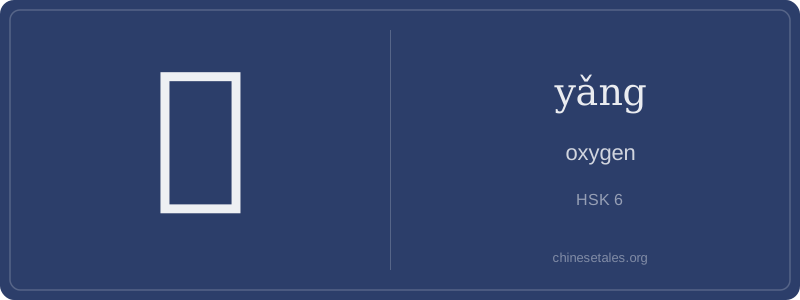
The character 氧 has no oracle bone or bronze script ancestry — it didn’t exist before 1858. When British missionary and chemist John Fryer collaborated with Chinese scholar Xu Shou to translate Western chemistry texts, they faced a dilemma: how to render ‘oxygen’ without importing alien sounds? They rejected phonetic transliterations (like *‘ou-si-jiu’*) and instead invented a new character rooted in Chinese logic. They chose the radical 气 (qì), already used for gases (e.g., 氢, 氮, 氯), and paired it with 羊 (yáng) — not for meaning, but because its pronunciation *yáng* matched the second syllable of the Japanese katakana rendering *sansō*, which Chinese scholars heard as *yang*. Visually, the top 气 (6 strokes) flows like rising vapor; the bottom 羊 (6 strokes, though simplified to 6 total in modern form) anchors it with familiar, stable curves — a deliberate fusion of function and familiarity.
This wasn’t linguistic imperialism — it was co-creation. Xu Shou insisted on using native radicals and phonetic components to maintain intelligibility within the character system. By 1907, 氧 appeared in official textbooks, and by the 1930s, it had fully displaced older terms like 養氣 (‘nourishing qi’) in scientific contexts. Interestingly, the character’s shape mirrors its function: the light, airy 气 above suggests volatility and buoyancy, while 羊 — historically associated with auspiciousness and abundance — subtly evokes oxygen’s life-sustaining role. No classical text mentions 氧, yet its creation is one of the most consequential acts of Chinese lexicography in the last two centuries.
At first glance, 氧 (yǎng) feels like a modern scientific intruder in the Chinese character family — and it is! Unlike ancient characters born from nature or ritual, 氧 was coined in the late 19th century during China’s intense encounter with Western chemistry. Its core meaning is strictly 'oxygen' — no poetic flexibility, no idiomatic drift. You’ll never see it used metaphorically like 'air' or 'spirit'; it’s a precision tool, always referring to the chemical element O₂ or oxygen atoms in compounds.
Grammatically, 氧 behaves like a noun that rarely stands alone: it almost always appears in compounds (e.g., 氧气, 缺氧) or as part of technical phrases. You won’t say *‘我需要氧’* — instead, you say *‘我需要氧气’* (I need oxygen gas) or *‘血氧饱和度’* (blood oxygen saturation). It never takes aspect particles (了, 过) or plural markers; it’s uninflected, immutable — like the element itself. A common learner mistake is overgeneralizing its use, such as writing *‘植物释放氧’* instead of the natural *‘植物释放氧气’* — native speakers instinctively add 气 (qi, 'vapor/gas') for phonological weight and semantic clarity.
Culturally, 氧 reflects China’s fascinating process of lexical modernization: rather than borrowing a foreign word (like ‘oxygen’), scholars adapted existing morphemes using classical logic. The choice of 气 (qi) as the radical signals ‘gaseous substance’, while 羊 (yáng) was selected purely for sound — a brilliant, pragmatic compromise between phonetics and tradition. This character doesn’t carry Daoist breath-concepts or medical qi theory — it’s deliberately stripped of classical ambiguity. That’s why HSK 6 includes it: not because it’s frequent in daily talk, but because it’s essential for reading science journalism, medical reports, or environmental policy.