沐
Character Story & Explanation
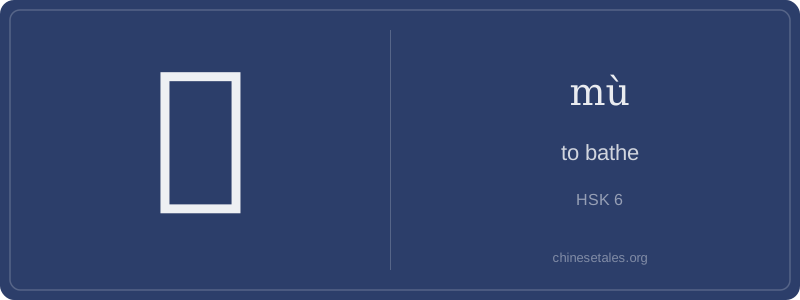
The earliest form of 沐 appears in Western Zhou bronze inscriptions: a pictograph showing three water droplets (氵) beside a simplified depiction of a person’s head and flowing hair — essentially ‘water falling on hair’. Over centuries, the ‘person’ element evolved into 木 (mù, ‘tree’), likely due to phonetic borrowing (both 沐 and 木 were pronounced *muk* in Old Chinese) and clerical script simplification. By the Han dynasty, the character stabilized as 氵+木 — seven clean strokes, where the water radical declares its domain, and 木 hints at both sound and the wooden tubs used for bathing in antiquity.
This visual shift didn’t erase meaning — it deepened it. In the *Book of Rites*, 沐 appears in protocols for ancestral rites: ‘三日而沐,五日而浴’ (bathe every three days, immerse fully every five). Here, 沐 specifically meant washing the hair — a distinct step before full bathing (浴). Even today, 沐 retains that nuance: it implies focused, headward cleansing, whether literal (沐发) or metaphorical (沐德, ‘bathed in virtue’). Its shape — water + wood — quietly reminds us that ancient baths used carved wooden vessels, and virtue, like water, must flow over the mind to cleanse it.
Imagine a quiet morning in an ancient Chinese scholar’s courtyard: steam rises from a bronze basin, water glistens on smooth stones, and the scholar stands barefoot, rinsing his hair with warm water infused with osmanthus — not just cleaning, but purifying mind and spirit before composing poetry. This is 沐 (mù): not merely ‘to bathe’ like the everyday verb 洗 (xǐ), but a deliberate, almost ritual act of cleansing — physical, moral, and symbolic. It carries elegance, intention, and quiet reverence.
Grammatically, 沐 is mostly used in formal or literary contexts — rarely as a standalone verb in modern spoken Mandarin. You’ll find it in compound verbs (e.g., 沐浴 mùyù) or passive/figurative constructions: ‘沐恩’ (receive grace), ‘沐风’ (bask in the wind). It’s never used for showering or washing dishes — that’s strictly 洗. Learners often overuse it, saying *‘wǒ mù yī ge zǎo’* (I bathe once a day) — which sounds like a Tang dynasty courtier reciting vows. Nope! Use 洗澡 instead.
Culturally, 沐 ties to Confucian ideals of self-cultivation: just as one rinses dust from the body, one must ‘bathe’ in virtue and wisdom. In classical texts like the *Chu Ci*, ‘沐兰汤’ (bathing in orchid-infused water) symbolized spiritual preparation. Modern usage preserves this dignity — you’ll see 沐 in brand names (e.g., 沐浴露 ‘bath gel’) or poetic headlines, but never in casual chat. Mistaking it for 洗 is like using ‘commence’ instead of ‘start’ — technically correct, but hilariously out of place.