沮
Character Story & Explanation
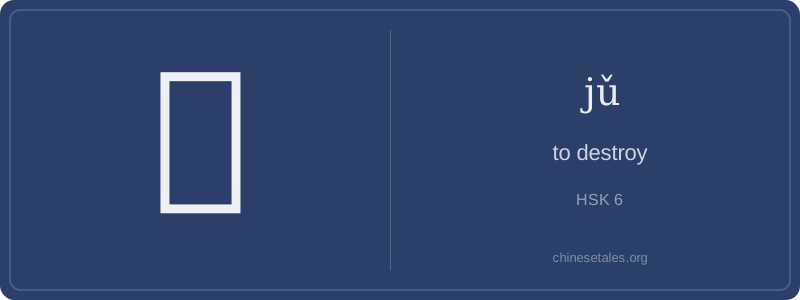
The earliest form of 沮 appears in bronze inscriptions as a combination of 氵 (water radical) and 且 (qiě), which originally depicted a ritual altar or ancestral tablet. Over time, 且 simplified into the modern right-hand component — not a phonetic placeholder, but a visual echo of something sacred being *submerged*. Imagine water rising around a stone tablet: the image isn’t of flooding, but of reverence being silently drowned out. By the seal script era, the three dots of water were standardized on the left, and the right side had lost its altar clarity, becoming more abstract — yet the watery ‘undermining’ idea held firm.
This visual logic directly shaped its meaning: in the *Zuo Zhuan* (c. 4th century BCE), 沮 appears in passages like ‘沮其谋’ (jǔ qí móu) — ‘to undermine their plan’, where water implies stealthy, non-confrontational sabotage. Unlike 破 (bèng, sudden break), 沮 suggests persistence: the drip that hollows the stone. Its usage remained elite and literary for centuries — favored by historians and strategists describing moral or strategic attrition, not battlefield carnage. Even today, 沮 retains that hushed, consequential weight: it’s the word for when hope doesn’t shatter — it just… sinks.
At first glance, 沮 (jǔ) feels like a quiet, almost reluctant verb — it doesn’t shout 'destroy!' like 破 or 灭. Instead, it conveys *gradual, dampened destruction*: the slow sapping of morale, the quiet collapse of resolve, or the erosion of confidence. Think of water seeping into foundations — not an explosion, but a subtle undermining. That’s why it almost always appears in compound verbs like 沮丧 (jǔ sàng) or with abstract nouns: you don’t ‘jǔ’ a building; you ‘jǔ’ someone’s spirit.
Grammatically, 沮 is nearly never used alone. It’s a classical root that now survives almost exclusively in set phrases — especially as the first syllable of two-character words. You’ll see it as a transitive verb in formal writing ('This news jǔ le his enthusiasm'), but learners often mistakenly try to use it like a standalone action verb (e.g., *‘I jǔ the plan’). Don’t! It’s not *do* destruction — it’s *cause to wilt*, and only in refined, literary, or psychological contexts.
Culturally, 沮 carries a Confucian-tinged gravity: it’s the kind of word you’d find in historical texts describing how slander (谗言) 沮了忠臣的进言 — not by shouting down, but by quietly poisoning trust. A common learner trap? Mixing it up with 咀 (jǔ, 'to chew') or 组 (zǔ, 'to organize') — sounds similar, but meanings are worlds apart. Remember: 沮 is always about *psychological erosion*, never physical force or neutral grouping.