沿
Character Story & Explanation
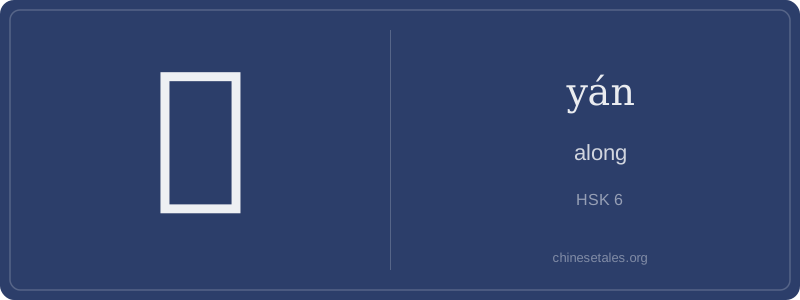
The earliest form of 沿 appears in bronze inscriptions as a flowing water symbol (氵) paired with a simplified depiction of a winding bank or shoreline — sometimes with a dot or stroke suggesting footsteps tracing its edge. Over time, the right side evolved from a pictograph of a curving embankment (original component 彡 or ⺄-like shape) into today’s simplified 口 + 丿 + 一 structure, which now looks abstract but retains the idea of following a contour. The left radical 氵 (three dots of water) anchors it firmly to aquatic boundaries — rivers, coasts, canals — reinforcing that this character was born from observing how people lived *beside* waterways, not on them.
By the Han dynasty, 沿 had expanded beyond literal water edges to include roads, borders, and even abstract lines of thought — as in 沿袭 (yánxí, 'to inherit [a tradition]'), where one follows the 'path' of precedent. The Tang poet Du Fu used 沿 in '沿江浦' ('along the riverbank') to evoke quiet, reflective movement — not haste, but contemplative continuity. Visually, the eight strokes themselves mimic flow: the three water dots ripple leftward, then the right side curves gently downward like a shoreline — you literally *trace* the character as you write it, echoing its meaning.
Think of 沿 (yán) not as a dry preposition like 'along', but as a quiet, flowing *path-following* — it’s the linguistic equivalent of trailing your finger along a riverbank or walking step-by-step beside a wall. Its core feeling is continuity, adjacency, and gentle parallel motion: you’re not crossing, jumping, or stopping — you’re staying in contact with a boundary or line, moving *with* it. That’s why it almost always appears before a noun indicating a linear feature: 沿河 (yán hé, 'along the river'), 沿海 (yán hǎi, 'along the coast'), 沿路 (yán lù, 'along the road').
Grammatically, 沿 is a preposition — but unlike English ‘along’, it *cannot stand alone*. You’ll never say 'We walked along' — you must say 'We walked along the river' → 我们沿河走 (wǒmen yán hé zǒu). Crucially, it’s not followed by 的 or other particles; it directly modifies the noun. Learners often mistakenly insert 是 or try to use it like a verb — but 沿 is strictly prepositional and unchangeable (no tenses, no aspect markers). Also, it rarely appears in spoken casual speech — it’s more literary or formal than 在…旁边, which is why HSK 6 learners encounter it in essays, news reports, and policy documents.
Culturally, 沿 carries a subtle sense of alignment — not just physical proximity, but adherence to a natural or administrative boundary. In classical texts, 沿 often appears in geographical descriptions (e.g., 《水经注》) to denote zones of influence or settlement patterns. A common mistake? Confusing it with 延 (yán, 'to extend') — same sound, totally different logic: 延 pushes outward; 沿 stays beside. And never confuse it with 沿着 (yánzhe), the colloquial compound — 沿 alone is the elegant, compact form used in high-level writing.