泌
Character Story & Explanation
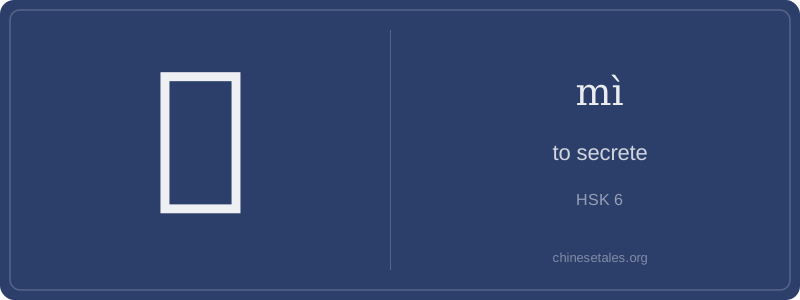
The earliest form of 泌 appears in bronze inscriptions as a combination of 氵 (water) and 必 (bì, originally depicting a hand holding a ritual vessel, later phonetic). In oracle bone script, no direct precursor exists — it emerged during the Warring States period as a phono-semantic compound: 氵 signals liquid-related meaning, while 必 provided pronunciation (though sound shifted from *pit* to *mì* over centuries due to dialectal borrowing and palatalization). Visually, the eight strokes flow downward: three dots for water, then the crisp, angular 必 — its central vertical stroke anchoring the whole character like a conduit for flow.
Originally, 泌 described natural exudation — dew condensing on grass, resin oozing from pine — long before biomedical usage. The Shuōwén Jiězì (121 CE) defines it as ‘water emerging from stone crevices’ (水從孔中出), linking it to hidden, persistent emergence. By the Tang dynasty, poets like Du Fu used 泌 metaphorically — ‘blood secretly wells’ — foreshadowing its modern physiological sense. Its visual economy — minimal strokes suggesting maximal internal activity — mirrors the Daoist ideal of effortless action (wúwéi): secretion happens not by command, but by inherent, quiet vitality.
At its core, 泌 (mì) isn’t just a clinical term for ‘secrete’ — it carries the quiet, invisible labor of life itself: hormones slipping into blood, sweat beading on skin, sap rising in bamboo. In Chinese, this character evokes a gentle, continuous outflow — never violent or forced — reflecting a deep cultural appreciation for subtle, internal processes that sustain balance (yīn-yáng harmony, qì flow). It’s almost never used transitively without an agent: you don’t ‘secrete something’ abstractly; you *bìng rén* (a patient) secretes insulin, or *gān zàng* (the liver) secretes bile — the subject is always a living, functional system.
Grammatically, 泌 is almost exclusively a verb and rarely stands alone. It appears in formal scientific, medical, or biological contexts — never in casual speech (you’d say 出汗 for ‘sweat’, not 泌汗 in daily talk). Learners often mispronounce it as bì (confusing it with 毕 or 必), but it’s firmly mì — like ‘me’ + ‘tea’ whispered softly. Also, it’s never used in imperative or colloquial constructions: you won’t hear ‘泌一下!’ — that would sound absurdly clinical, like yelling ‘Secrete now!’ at your adrenal glands.
Culturally, 泌 embodies the Chinese view of the body as a microcosm of nature: just as mountains seep spring water (a classical association), organs ‘leak’ vital substances in rhythm with seasons and emotions. A common mistake? Using 泌 where 分泌 is required — the latter is the full, standard compound (e.g., 分泌激素), while 泌 alone feels clipped, poetic, or archaic unless in tightly controlled technical prose or compound words.