泣
Character Story & Explanation
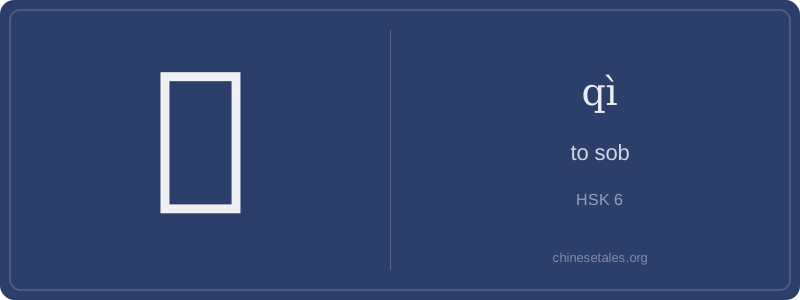
The earliest form of 泣 appears in bronze inscriptions as a combination of 水 (shuǐ, water) on the left and 立 (lì, to stand) on the right — but here, 立 wasn’t about standing; it was a phonetic loan representing the ancient pronunciation *k-ləp*, later simplified into 乞 (qǐ). Over centuries, the right side evolved: from 立 + 一 + 丨 to 乞 (a stylized 'begging hand' shape), while the left retained its three-dot water radical 氵 — visually anchoring the character to tears as liquid. By the Han dynasty, the structure solidified into today’s eight-stroke form: three dots for water, then 乞 stacked neatly to the right — each stroke deliberate, like tear drops falling in measured rhythm.
This visual logic shaped its meaning: tears aren’t just water — they’re water *released by emotion*, so the radical grounds it in physiology while the phonetic 乞 hints at vulnerability (as in 'begging' or 'pleading'). Classical texts lean into this duality: in the Book of Songs, 泣 describes wives weeping at war’s departure — not hysterically, but with solemn, unstoppable flow. Later, in Tang poetry, 泣 becomes almost musical: 泣血 (qì xuè, 'weeping blood') isn’t literal, but conveys grief so intense it transcends physical limits — showing how the character’s structure invites metaphorical expansion far beyond mere sobbing.
Think of 泣 (qì) as Chinese literature’s equivalent of a single, perfectly placed tear rolling down a cheek in a black-and-white film — not full-blown crying (that’s 哭 kū), but the quiet, dignified, emotionally charged sob that signals deep sorrow without spectacle. It’s the soundless tremor in the voice, the choked breath before words fail. In English, it’s closer to 'to weep' or 'to sob' than 'to cry' — more literary, more restrained, and almost always tied to grief, loss, or profound empathy.
Grammatically, 泣 is primarily a verb, but unlike most verbs, it rarely stands alone. You’ll almost never hear someone say '他泣' — instead, it appears in compound verbs (e.g., 抽泣 chōuqì 'to sob convulsively'), fixed expressions (如泣如诉 rú qì rú sù 'like weeping, like pleading' — describing mournful music), or classical-style constructions where it functions adverbially or as a resultative complement. It also frequently appears in passive or descriptive phrases: 悲泣 (bēi qì, 'grieving sob') or 泣下 (qì xià, 'tears fall'). Learners often mistakenly use it like 哭 in casual speech — a subtle but jarring error, like using 'lament' instead of 'cry' at a birthday party.
Culturally, 泣 carries heavy literary weight: it’s the sob in Du Fu’s poems mourning fallen dynasties, the silent tear in Tang dynasty love laments, and the emotional climax in modern novels where restraint speaks louder than wailing. Misusing it (e.g., saying '我泣' instead of '我哭了') marks you as either quoting poetry or accidentally sounding like a Ming-dynasty scholar at a coffee shop — charming, but contextually off.