洪
Character Story & Explanation
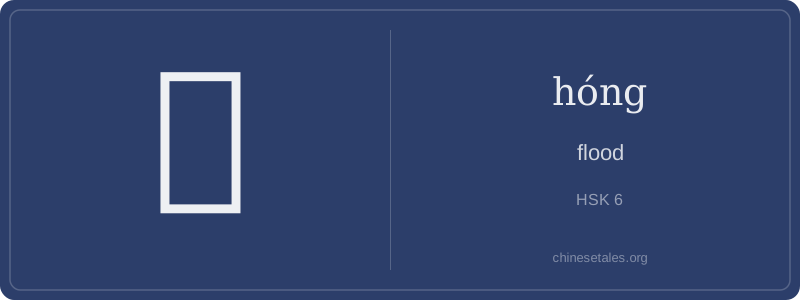
The earliest form of 洪 appears in late Western Zhou bronze inscriptions: a flowing water symbol (like 氵) paired with a stylized ‘hand holding something together’ (the ancestor of 共). By the Warring States period, it had settled into the structure we know — three water dots on the left, 共 on the right — with strokes deliberately arranged to suggest water converging and rising. Notice how the top stroke of 共 arcs like a swelling wave, and the bottom horizontal stroke grounds the flood’s immense weight.
This character wasn’t born from observation alone — it was forged in trauma. The Shujing (Book of Documents) recounts the ‘Great Flood’ (大洪) that lasted nine years before Yu’s intervention. In classical poetry, 洪 appears in phrases like 洪波 (hóng bō, ‘great waves’) — not just big waves, but waves that reshape coastlines. Its visual balance — fluid yet structured, chaotic yet bounded — mirrors the ancient ideal: harnessing overwhelming force through wisdom, not suppression.
At its heart, 洪 isn’t just ‘flood’ — it’s *the* flood: vast, unstoppable, mythic. Think not of a puddle after rain, but the primordial deluge that carved rivers and drowned empires. Its radical 氵 (three dots of water) immediately signals aquatic force, while the right side 共 (gòng, ‘together’) hints at collective, overwhelming scale — water gathering *en masse*. This isn’t a gentle overflow; it’s water in unison, surging beyond bounds.
Grammatically, 洪 is almost never used alone as a verb. You won’t say ‘it floods’ with 洪 — instead, it appears in compound nouns (洪水, 洪灾) or as an adjective meaning ‘massive’ or ‘torrential’ (e.g., 洪流 ‘torrential current’, 洪量 ‘huge volume’). Learners often mistakenly try to use it like English ‘flood’ as a verb — a classic HSK 6 trap! Correct usage leans on fixed terms: you ‘suffer a flood’ (遭受洪水), not ‘flood the city’ with 洪.
Culturally, 洪 evokes the Great Yu Flood — the foundational Chinese myth where Yu tamed the waters not by damming, but by channeling. So 洪 carries weight: chaos, divine-scale danger, *and* the human triumph over it. Also beware — in modern slang, 洪 can appear in internet terms like 洪荒之力 (hóng huāng zhī lì, ‘primordial power’), referencing cosmic chaos. It’s poetic, historical, and slightly terrifying — never casual.