涉
Character Story & Explanation
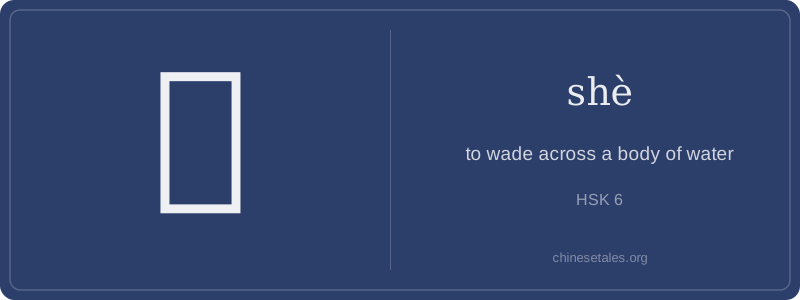
The earliest form of 涉 appears in Western Zhou bronze inscriptions as a vivid pictograph: two feet (止) on either side of flowing water (巛), literally showing a person stepping into and across a stream. Over centuries, the water evolved from three wavy lines (巛) into the modern three-dot radical 氵, while the ‘feet’ merged and stylized into the right-side component 步 — which itself contains two 止 (feet) stacked vertically. So 涉 isn’t just ‘water + foot’ — it’s ‘water + double footsteps’, emphasizing *repeated, deliberate steps across* — no splashing, no swimming, just steady wading.
This visual logic shaped its semantic journey: from concrete river-crossing in the Shījīng (Book of Odes) — ‘涉淇,采蕨’ (wading the Qí River to gather bracken) — to abstract involvement by the Warring States period. Mencius uses 涉 to describe rulers who ‘wade into’ people’s suffering, making it a moral verb of engagement. The character never lost its undertone of vulnerability: to 涉 something is to enter it deeply, knowing you’re immersed — and potentially implicated.
Imagine you’re trekking through misty mountains in southern China, and the only path forward crosses a shallow, rushing stream. You roll up your trousers, step in carefully — feeling cold water swirl around your ankles, stones shifting underfoot — and slowly make your way across. That deliberate, cautious crossing? That’s 涉 (shè). It’s not just ‘to cross’ — it’s to wade *through*, to engage physically and attentively with a medium that resists easy passage. This character carries weight: it implies effort, risk, and immersion — whether literal water or metaphorical terrain.
Grammatically, 涉 is almost always used in compounds or formal written contexts; you’ll rarely see it alone in speech. It pairs with nouns to form verbs like 涉及 (shèjí, 'to involve') or 涉嫌 (shèxián, 'to be suspected of'), and it’s common in legal, academic, and journalistic registers. Learners often mistakenly use it like the casual 走过 (zǒuguò, 'walk past') — but 涉 isn’t passive or breezy. It’s solemn, consequential, and nearly always followed by a direct object: 涉及利益, 涉及外交, 涉及机密.
Culturally, 涉 evokes classical restraint — think of Confucian scholars wading across rivers as metaphors for moral passage. A common error is overusing it in spoken Chinese (e.g., saying 我涉过河 instead of the natural 我蹚水过河); native speakers reserve 涉 for writing or elevated speech. Also, note its tone: shè (4th) — never shē or shě — and its radical 氵 signals water, but the meaning has long since broadened far beyond H₂O.