涵
Character Story & Explanation
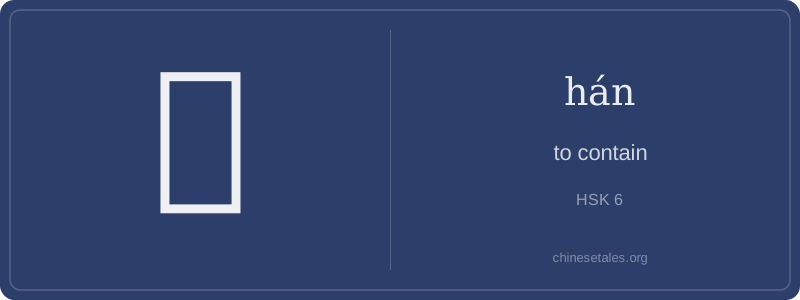
The earliest form of 涵 appears in seal script (c. 3rd century BCE), built from 氵 (water radical) on the left and 函 (hán, 'box' or 'case') on the right — a clear semantic-phonetic compound. The water radical wasn’t about liquid here; it signaled 'fluid containment' — how water gently holds dissolved minerals, shapes riverbanks without force. The right side 函 originally depicted a sealed wooden case with a lid, used in ancient China to store ritual bronzes or bamboo slips. Over centuries, the seal script’s rounded curves sharpened into regular script: the three dots of 氵 stabilized into a tidy left-hand column, while 函 simplified — its top 'lid' (凵) and inner 'arrow' (丷+一) condensed into today’s compact 11-stroke form.
This visual logic shaped its meaning: just as a sealed box holds precious objects *and* protects their integrity, and water holds nutrients *without consuming them*, 涵 came to mean 'to contain *while preserving essence*'. In the Book of Rites, scholars praised rulers who '涵天地之德' — not merely 'possess' virtue, but *hold it within like deep water*, letting it nourish others silently. By the Tang dynasty, poets like Du Fu used 涵 to describe mist 'containing' mountains — a poetic fusion of physical presence and atmospheric resonance. Its power lies precisely in this duality: structural containment + subtle, life-sustaining absorption.
Think of 涵 as Chinese’s elegant version of a 'semantic Tupperware container' — not just holding things physically, but preserving nuance, depth, and unspoken meaning. Unlike English verbs like 'contain' or 'include', which are often literal (e.g., 'The box contains nails'), 涵 implies gentle, respectful containment: it’s what a scholar’s essay does with classical allusions, what a smile does with unspoken kindness, or what silence does with heavy emotion. It’s rarely used for brute physical volume — you wouldn’t say 这个箱子涵三本书 ('This box hán three books'); that’s where 包含 or 装 shines.
Grammatically, 涵 is almost always transitive and formal — common in written language, academic discourse, and literary critique. It pairs naturally with abstract nouns: 涵义 (implicit meaning), 涵养 (cultivated moral depth), 涵盖 (to cover comprehensively, often in scope or theory). You’ll see it in passive constructions too: 该词涵有多重文化隐喻 ('This term hán multiple cultural metaphors'). Note: it’s *not* used as a standalone verb in casual speech — no one says '我涵不住了!' (unlike 忍 or 爆). That’s a classic HSK 6 trap.
Culturally, 涵 carries Confucian weight: to 涵 is to internalize virtue quietly, not display it loudly. Mistake it for the more neutral 包含, and your sentence loses its layer of cultivated restraint — like swapping 'imbued with dignity' for 'has dignity'. Also, watch tone: hán (second tone) is easily mispronounced as hàn (fourth tone), which means 'sweat' or 'to sweat' — imagine praising someone’s 'cultural hàn' instead of 'cultural hán'!