淋
Character Story & Explanation
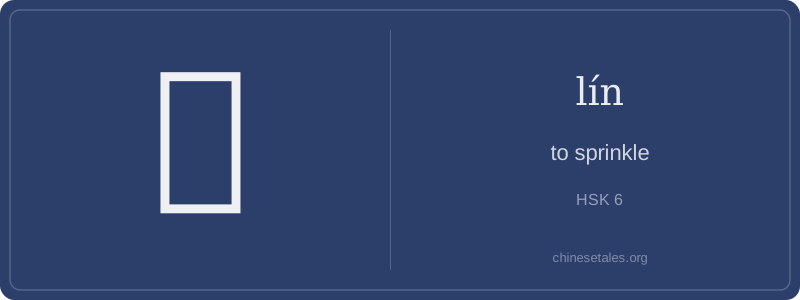
Trace 淋 back to its earliest forms, and you’ll find no single pictograph — it’s a later phono-semantic compound, created during the Warring States period. Its left side, 氵, evolved from the full character 水 (shuǐ, ‘water’), simplified into three flowing dots representing ripples or droplets. The right side, 林, originally depicted two trees side-by-side (two 木 characters), symbolizing a dense grove — and by the Han dynasty, scribes combined these elements: water flowing *through* the forest’s layers. Stroke by stroke, the modern form solidified: three water dots, then the top horizontal of 林, followed by two parallel verticals (the tree trunks), and finally the crisscrossing strokes mimicking intertwined branches and falling rain.
This visual logic shaped its meaning from the start: not just ‘water + trees’, but ‘water *percolating* — filtered, softened, repeated’. In the Shuōwén Jiězì (121 CE), it’s defined as ‘water descending continuously’, capturing both rhythm and penetration. By the Tang dynasty, poets like Du Fu used 淋 metaphorically — ‘tears淋ing the sleeve’ — showing how early the character bridged physical action and emotional saturation. That layered, filtering quality remains central: whether rain on bamboo or grief soaking through composure, 淋 always implies a medium through which liquid moves — never raw force, always mediation.
At its heart, 淋 (lín) is all about *liquid in motion* — not a flood, not a drip, but a steady, controlled cascade: rain falling through leaves, water sprinkling over herbs, or even tears welling and spilling. The left radical 氵 (‘water’) immediately grounds it in the realm of fluids, while the right side 林 (lín, ‘forest’) isn’t just decorative — it’s phonetic *and* semantic: forests are dense, layered, and rain naturally filters *through* their canopy, creating that gentle, penetrating ‘sprinkle’ effect. This dual role makes 淋 feel tactile and atmospheric — you don’t just see the water; you feel its texture and path.
Grammatically, 淋 is most often used as a verb in compound verbs like 淋浴 (lín yù, ‘to shower’) or as a resultative complement after verbs of motion: 洗淋 (xǐ lín, ‘wash until soaked’) or 淋湿 (lín shī, ‘to get drenched’). Crucially, it rarely stands alone — you won’t say ‘I淋 the plant’; instead, you say 给花淋水 (gěi huā lín shuǐ, ‘sprinkle water on the flowers’). Learners often mistakenly use it transitively without specifying the liquid or direction, leading to unnatural phrasing.
Culturally, 淋 carries subtle connotations of purification and renewal — think of Buddhist rituals where holy water is gently sprinkled, or traditional Chinese medicine practices like 淋洗 (lín xǐ, ‘rinsing herbs’). A common trap? Confusing it with 淋 (lìn), the rare alternate reading used only in classical compounds like 淋漓 (lìn lí, ‘profuse, unrestrained’ — as in blood or emotion), which evokes intensity rather than gentleness. Don’t worry — in modern speech, lín is overwhelmingly dominant.