淹
Character Story & Explanation
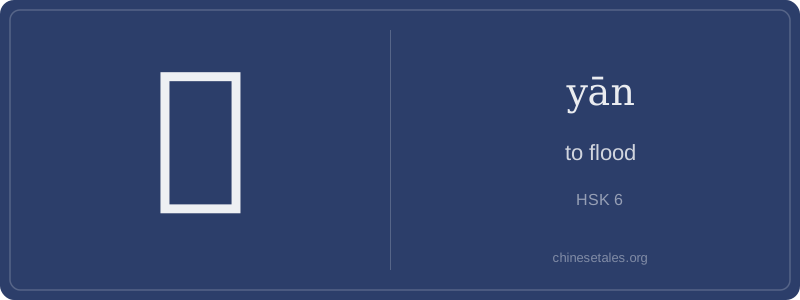
The earliest form of 淹 appears on Warring States bamboo slips — not as a pictograph, but as a phonosemantic compound already fully formed. Its left side is 氵 (the ‘water’ radical), clearly signaling aquatic meaning. The right side is 掩 (yǎn), which originally meant ‘to cover’ or ‘to conceal’ — and yes, that same character appears here as a phonetic clue (both 淹 and 掩 share the -ān rhyme and similar ancient pronunciation). Visually, the eleven strokes flow downward: three dots for water, then a compact, slightly compressed 掩 — as if water is pressing down, sealing the ground beneath.
This structure wasn’t accidental: by the Han dynasty, 淹 had crystallized its core sense of ‘gradual, complete submersion’ — distinct from violent verbs like 冲 (chōng, ‘to rush’) or 溃 (kuì, ‘to breach’). In the Records of the Grand Historian, Sima Qian uses 淹 to describe how the Yellow River ‘淹田庐’ (yān tián lú) — ‘submerged farmland and homes’ — emphasizing loss through quiet persistence, not sudden force. Even today, the character’s visual weight — that dense, downward-tugging right side — mirrors its semantic load: water not just falling, but *settling in*, claiming space.
Imagine a sudden summer cloudburst in the Yangtze River basin: rain pours for days, rivers swell past their banks, and low-lying villages vanish beneath churning, tea-colored water — not with a roar like a tsunami, but with a slow, suffocating, inescapable rise. That’s 淹 (yān): it doesn’t just mean ‘flood’ as a noun or event; it captures the *process* of submersion — water creeping over land, drowning fields, silencing streets, even metaphorically drowning voices or hopes. It’s visceral, relentless, and deeply atmospheric.
Grammatically, 淹 is almost always a verb, used transitively (it needs an object), often in formal or literary contexts. You’ll rarely hear it in casual speech — people say 发大水 (fā dà shuǐ) for ‘there’s flooding’. But in writing? It’s indispensable: 淹没 (yānmò) ‘to submerge’, 淹死 (yānsǐ) ‘to drown’, or the elegant passive construction 被洪水淹了 (bèi hóngshuǐ yān le) ‘was flooded by the floodwaters’. A common mistake: learners try to use 淹 alone as a noun (‘a flood’) — nope! It’s strictly action-oriented. Also, don’t confuse its tone: yān (first tone), not yàn (fourth) like 厌.
Culturally, 淹 carries historical gravity. Ancient texts like the Book of Documents describe floods that ‘淹九州’ (yān jiǔ zhōu) — ‘submerged the Nine Provinces’ — framing floods as civilizational threats requiring sage-kings like Yu the Great to tame them. Today, it appears in environmental reports, disaster warnings, and even poetic metaphors: ‘忧愁淹没了她’ (yōuchóu yānmò le tā) — ‘sorrow submerged her’. Its weight reminds us that in Chinese, water isn’t just physical — it’s moral, political, and deeply human.