渠
Character Story & Explanation
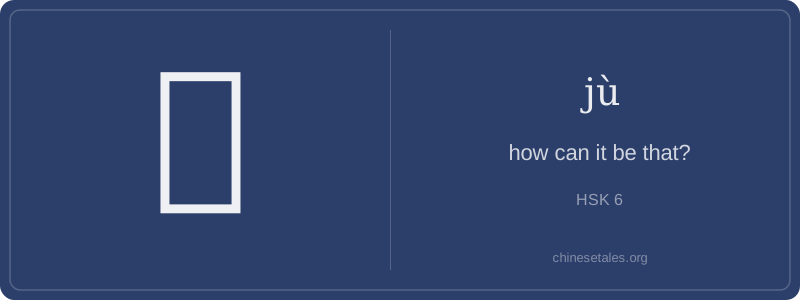
Look closely at 渠: three dots on the left (氵, water), then a complex right side. In oracle bone script, there was *no* early form for this specific interrogative use — because it didn’t exist yet! The character originally depicted a *water channel* (qú): the left side 氵 clearly shows flowing water; the right side 巨 (jù) — meaning 'huge' — was added phonetically, suggesting something large and engineered, like an irrigation ditch. Over centuries, bronze inscriptions simplified the water dots and standardized 巨 as the phonetic component.
Then came the semantic twist: during the Han and Wei-Jin periods, scholars began using the *sound* jù (from 巨) to write the classical pronoun 'he/him/it' — written as 渠 in dialectal texts like the Shi Shuo Xin Yu. Later, by Tang-Song times, writers repurposed that same sound and graph to express rhetorical disbelief — 'How *could* it be that *he*…?' — eventually fossilizing into the standalone interrogative 渠 (jù). So visually: water + giant = canal → sound borrowed for 'he' → sound repurposed for 'how can it be?!' — a stunning case of phonetic drift becoming grammatical magic.
Let’s cut through the confusion: 渠 (jù) isn’t a noun meaning 'canal' here — that’s its *other* pronunciation, qú. At HSK 6, you’ll meet it as a classical interrogative particle meaning 'how can it be that?' or 'how is it possible that?' It’s literary, emphatic, and always appears at the *beginning* of rhetorical questions expressing disbelief, indignation, or profound wonder — like an ancient Chinese eyebrow raise. Think of it as the Mandarin equivalent of 'How on earth…?' or 'What in the world…?'
Grammatically, 渠 (jù) is always followed by a verb phrase and ends with 吗, 呢, or more commonly, no particle at all — the tone does the work. For example: 渠能如此?(jù néng rúcǐ?) — 'How can he possibly be like this?' Notice how it replaces modern structures like 怎么可能…? but packs more emotional gravity. Learners often misread it as qú and try to translate it as 'canal', leading to hilarious non-sequiturs like 'The canal can be like this?'
Culturally, this usage survives almost exclusively in formal writing, classical allusions, or stylized speech (e.g., historical dramas or satirical essays). It’s not conversational — using it over coffee will make your friends blink and check if you’ve been reading the Zuo Zhuan. A subtle trap: it’s easily confused with 何 (hé, 'what') or 豈 (qǐ, 'how could it be?'), but 渠 (jù) carries a uniquely archaic, almost poetic weight — less logical, more visceral.