港
Character Story & Explanation
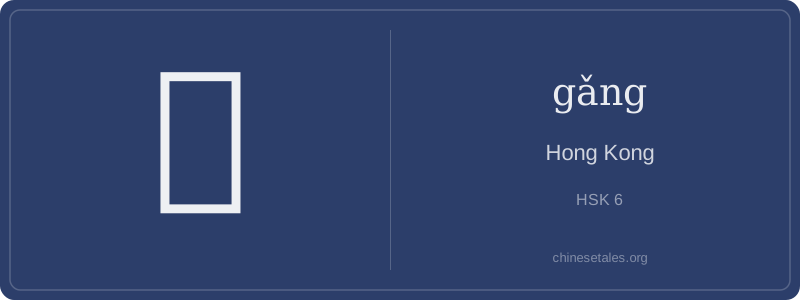
The earliest form of 港 appears in Han dynasty clerical script as a combination of 氵 (water radical) and 巷 (xiàng, ‘alley’ or ‘narrow lane’ — originally picturing two walls enclosing a passage). Visually, it was a brilliant conceptual blend: water + a narrow, sheltered passageway — exactly what a natural harbor looks like from above. Over time, 巷 simplified: its roof radical 宀 flattened, the ‘two people’ 丿丨 merged into a single diagonal stroke, and the bottom ‘earth’ 土 became 口 — yielding today’s right-hand component 巷 (though now stylized beyond recognition). Twelve strokes total: three dots for water, then nine for the evolved alley.
This visual logic anchored its meaning: a place where water flows *into shelter*, not open sea. By the Tang dynasty, 港 appears in poetry describing coastal trade hubs — Du Fu even alluded to ‘southern 港s’ where merchants unloaded spices. Crucially, it never meant ‘ocean’ or ‘river’; its genius lies in implying *containment and interface*. That’s why 香港 wasn’t named for fragrance alone — it was the fragrant *harbor*, the safe inlet where junks docked and incense warehouses lined the shore. The character’s shape is literally a map: water flowing into a protective channel.
At its heart, 港 isn’t just ‘Hong Kong’ — it’s a *sheltered waterway*. The character evokes the feeling of calm, protected space: think of a natural harbor tucked between hills, where waves hush and ships rest safely. That’s why 港 carries deep connotations of refuge, access, and strategic connection — not just geography, but geopolitical gravity. In modern Chinese, it functions primarily as a noun (e.g., 香港, 深圳港), but crucially, it also appears in abstract compounds like 港湾 (harbor/bay) or 港口 (port), where it retains that core sense of ‘a place where flow meets safety’.
Grammatically, 港 rarely stands alone outside proper nouns — you won’t say *‘I went to 港’* without specifying which one. Learners often overgeneralize it as a generic word for ‘city’ or ‘region’, but no: it’s tightly bound to maritime infrastructure or toponymy. You’ll see it in formal contexts like 港澳 (Gāng’ào — Hong Kong and Macau), where it’s part of a fixed binomial compound. And yes — it’s pronounced gǎng, *not* gāng; the third tone is non-negotiable, and mispronouncing it as gāng (like 刚) can accidentally evoke ‘just now’ instead of ‘harbor’.
Culturally, 港 is loaded with layered resonance: it’s the ‘Gang’ in 香港 — literally ‘Fragrant Harbor’, named after incense-scented waters and trading junks centuries ago. But today, it’s shorthand for autonomy, global finance, and linguistic hybridity (Cantonese + English). A common mistake? Assuming all 港-words are about Hong Kong — but 湛江港 (Zhanjiang Port) or 天津港 (Tianjin Port) prove it’s fundamentally *about port function*, not just the Special Administrative Region.