凑
Character Story & Explanation
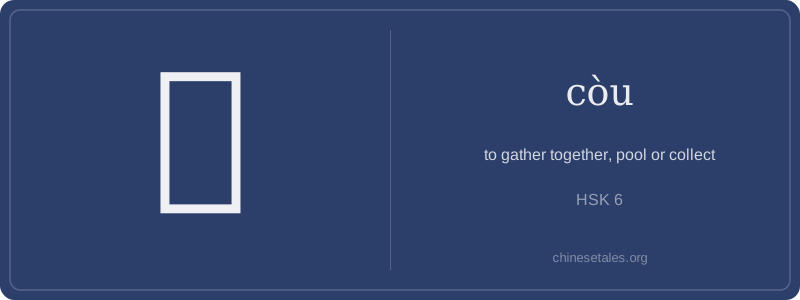
The earliest form of 凑 appears in Warring States bamboo texts, evolving from a bronze script combining 冫 (bīng — ‘ice’, here acting phonetically and evoking cold, sharp convergence) and 凵 (kǎn — a pit or container) plus a hand-like component (廾 gǒng) reaching inward. Over centuries, the pit simplified into 曲 (qū — ‘bend’), and the hand merged with the right side, crystallizing into the modern 凑: 冫 + 奏. The ‘ice’ radical isn’t about temperature — it signals crisp, directed motion, like shards converging toward a point. Stroke order reveals intentionality: the two icy dots (冫) anchor the action before the complex ‘奏’ (zòu — ‘to present’) follows — as if saying, ‘First, gather the pieces; then, present them.’
This visual logic mirrors its semantic journey: from early uses meaning ‘to approach closely’ (e.g., in the Zuo Zhuan, describing troops converging on a city), it shifted during the Tang dynasty to emphasize *aggregation for utility* — pooling grain for famine relief, or contributions for temple repairs. By the Ming-Qing vernacular novels, 凑 had fully embraced colloquial warmth: ‘凑热闹’ (còu rènao — ‘join the lively crowd’) wasn’t just physical presence, but emotional participation. Its shape — icy precision meeting musical presentation — captures this duality: methodical yet human, structured yet spontaneous.
Think of 凑 (còu) as the Chinese equivalent of 'scraping together' — not in a desperate way, but like gathering spare change from couch cushions to buy concert tickets: purposeful, slightly improvisational, and always collective. It’s not about passive accumulation (like 收集 shōují), but active convergence toward a shared goal — money, people, ideas, or even excuses. This character hums with the energy of real-world pragmatism, the kind you feel when friends text ‘凑个局’ (còu gè jú) — literally ‘gather a gathering’ — to organize dinner at the last minute.
Grammatically, 凑 is highly versatile: it can be transitive (凑钱 còu qián — ‘pool money’) or intransitive (人还没凑齐 rén hái méi còu qí — ‘people still haven’t gathered’), and appears frequently in resultative complements (凑够 còu gòu — ‘gather enough’) and colloquial verbs like 凑合 (còu huo — ‘make do’). Crucially, it almost never stands alone — it demands context: what’s being gathered? For whom? Toward what end? Learners often mistakenly use it where English says ‘collect’ or ‘assemble’, missing its inherent connotation of *partial, collaborative effort* — not perfection, but sufficiency.
Culturally, 凑 reflects a deeply relational worldview: value emerges not in isolation, but in aggregation — whether funds for a wedding gift, signatures for a petition, or laughter around a table. A common error is overusing it for neutral collection (e.g., collecting stamps); instead, reserve it for moments where human coordination, compromise, or resourcefulness is central. It’s the quiet verb behind grassroots organizing, group chats, and the universal sigh of relief when the final person finally walks through the door.