涌
Character Story & Explanation
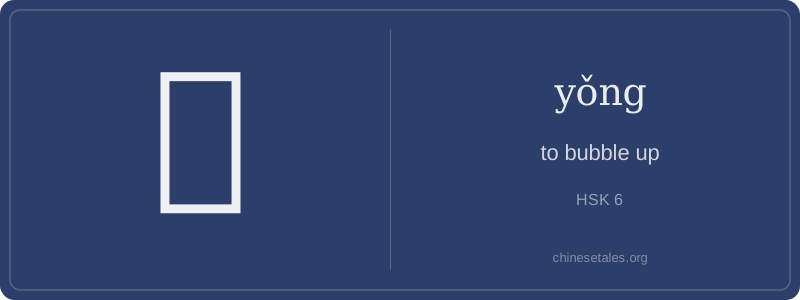
The earliest form of 涌 appears in Warring States bamboo slips as a flowing-water radical (氵) paired with a phonetic component 甬 (yǒng), which itself originally depicted a bell-shaped vessel with an open top — suggesting resonance, hollow space, and upward release. The water radical anchors the meaning in fluid motion, while 甬 provided both sound and conceptual weight: imagine water surging *up through the opening* of a narrow vessel, building pressure until it bursts forth. Over centuries, the 甬 component simplified from a detailed vessel shape to today’s clean, angular strokes — yet the visual logic remains: three water drops on the left, and on the right, a structure () topped by a 'mouth'-like opening (用), evoking containment giving way to eruption.
This idea of contained energy breaking surface became central in classical usage. In the Classic of Poetry, 涌 describes spring water gushing from mountain crevices; by the Tang dynasty, poets like Du Fu used it metaphorically — 'grief 涌ing in my chest' — extending the physical surge to emotional intensity. The character’s stability lies precisely in its duality: the calm, repetitive water dots (氵) contrast with the tense, upward-thrusting 甬 — a visual tug-of-war between restraint and release that mirrors its semantic core.
Think of 涌 (yǒng) as Chinese’s version of a champagne cork popping — not just 'rising', but rising with energy, pressure, and sudden release. It’s the verb for things that surge upward from within: emotions welling up, crowds flooding in, ideas bursting forth. Unlike generic 'rise' verbs like 升 (shēng) or 上 (shàng), 涌 implies irresistible, liquid-like force — it’s inherently dynamic and often collective. You’ll never say 'the sun 涌s' (that’s 升); you *will* say 'tears 涌 from her eyes' or 'protesters 涌 into the square'.
Grammatically, 涌 is almost always intransitive and frequently appears in vivid compound patterns: 涌现 (yǒngxiàn, 'to emerge suddenly'), 涌入 (yǒngrù, 'to flood into'), or as part of literary similes ('his anger 涌上心头'). It rarely takes an object directly — instead, it pairs with prepositions like 向 (toward), 入 (into), or 上 (upward). Learners often mistakenly use it like 'appear' or 'happen', but 涌 always carries that visceral, pressurized motion — like water forcing its way through cracks in concrete.
Culturally, 涌 appears in classical poetry to evoke natural power (e.g., Li Bai’s waves 涌ing against cliffs) and modern political discourse to describe mass movements ('public opinion 涌起'). A common error? Using it where English says 'arise' without the physicality — e.g., saying 'a problem 涌s' instead of 浮现 (fúxiàn) or 出现 (chūxiàn). Remember: if there’s no implied pressure, flow, or collective momentum, 涌 isn’t the right choice.