司
Character Story & Explanation
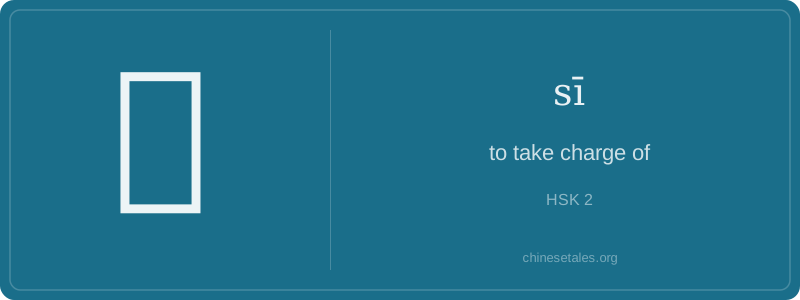
The earliest form of 司, found on Shang dynasty oracle bones, looks like a hand () reaching toward or holding a mouth (口) — not speaking, but *directing* speech. Imagine a ritual officer guiding chants during ancestral worship: the hand controls the mouth’s utterance. Over time, the hand simplified into the top stroke (一), then the left-falling stroke (丿), while the mouth (口) remained intact — giving us today’s clean, compact five-stroke shape: 一丿丨口。No extra flourishes, just precision: authority distilled into minimal strokes.
This 'directed mouth' concept evolved from concrete ritual control to abstract administrative oversight. In the *Zuo Zhuan*, a 4th-century BCE historical text, 司 appears in phrases like 司寇 (*sīkòu*, 'minister of justice'), where the official didn’t just speak law — he *governed its articulation*. By the Han dynasty, 司 was standard in bureaucratic titles, always paired with a domain: 司马 (*sīmǎ*, 'minister of horses' → later 'marshal'), 司徒 (*sītú*, 'minister of civil affairs'). The mouth never vanished — it’s still there, reminding us that true authority in Chinese tradition begins not with force, but with *regulated voice*.
Think of 司 like the 'CEO' character — not because it means 'chief executive officer' (that’s a modern borrowing), but because it carries the same quiet authority as a boardroom title: no shouting, no force, just inherent responsibility. In Chinese, 司 doesn’t shout 'I command!' — it whispers 'I oversee, I manage, I am entrusted.' It’s the verb behind government departments (司法 *sīfǎ*, 'judicial affairs'), company roles (司机 *sījī*, 'driver'—literally 'one who manages the vehicle'), and even ancient rituals (司礼 *sīlǐ*, 'to officiate rites'). Unlike English verbs that need auxiliaries ('is in charge of'), 司 stands alone as a transitive verb: 司职 (*sī zhí*) means 'to hold office,' no prepositions required.
Grammatically, it’s formal but not archaic — common in news, official notices, and job titles, yet rare in casual speech. Learners often overuse it trying to sound 'advanced,' saying *wǒ sī guǎn zhè ge* ('I manage this') when native speakers would say *wǒ fùzé zhè ge* ('I’m responsible for this'). Why? Because 司 implies institutional authority, not personal effort. Also, it almost never appears without a noun complement — you don’t just 'si' into the void; you *si* something specific: 司法、司仪、司职.
Culturally, 司 is a 'power-without-posterity' character: it governs quietly, like a conductor who never raises the baton. Its radical 口 ('mouth') hints at spoken mandate — not raw power, but delegated voice. A classic mistake? Confusing it with 去 (*qù*, 'to go') or 同 (*tóng*, 'same') due to visual similarity — but those are semantic dead ends. 司 isn’t about motion or sameness; it’s about stewardship. And yes — its 5-stroke simplicity belies centuries of bureaucratic weight.