溶
Character Story & Explanation
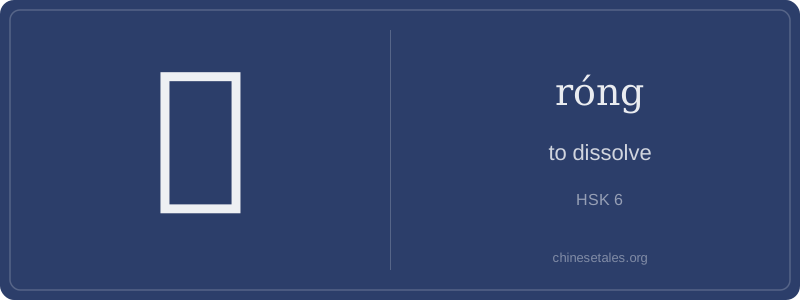
The earliest form of 溶 appears in seal script (c. 3rd century BCE), built from 氵 (the water radical) on the left and 容 (róng, 'to hold, contain') on the right — no pictograph of melting ice or bubbling liquid. The original idea wasn’t 'disappearing', but 'water holding something within itself' — visualizing how water *receives* and *envelops* a substance until it’s indistinguishable. Stroke-by-stroke, the three dots of 氵 evolved from wavy water lines; 容 retained its roof-like 宀 (roof), mouth 口, and a simplified vessel shape — all hinting at containment and capacity.
This 'water-containing' concept deepened in Han dynasty medical texts, where 溶 described how herbs release active compounds *into* decoctions — not destruction, but transformation through integration. By the Tang, poets used 溶 metaphorically: Li Bai wrote of moonlight 'dissolving' into river mist (月溶江雾), evoking gentle permeation rather than erasure. Even today, the character’s structure whispers its truth: dissolution isn’t annihilation — it’s water making space, and容 (róng) reminding us that to dissolve is, literally, to make room.
Think of 溶 (róng) as the Chinese counterpart to the word 'dissolve' in chemistry class — but with poetic license. It’s not just about sugar vanishing in tea; it’s the quiet, irreversible merging of boundaries: salt in seawater, ice under spring sun, even abstract things like 'doubts dissolving' or 'tensions dissolving'. Unlike English, where 'dissolve' is mostly technical or metaphorical, 溶 feels neutral and physical — it rarely carries emotional weight on its own, but becomes powerful when paired (e.g., 溶解疑虑, 'dissolve doubts').
Grammatically, 溶 is almost always transitive and requires an object — you can’t just 'dissolve' alone. It’s commonly used in the verb-complement structure 溶解 (róngjiě), or as part of passive constructions like 被溶解 ('was dissolved'). Crucially, it’s *not* used for melting solids by heat alone (that’s 融 or 熔); 溶 specifically implies interaction with a solvent — water, acid, time, even empathy. Learners often mistakenly say 溶化 instead of 融化 for 'melt' — a subtle but critical slip that chemists (and exam graders) will notice.
Culturally, 溶 appears in classical Daoist texts describing how rigid intentions 'dissolve' into the flow of the Dao — a metaphor still alive in modern essays. Also watch out: while 溶 is HSK 6, it’s rarely used standalone in speech; native speakers prefer context-rich phrases like 溶于水 ('dissolves in water') or 溶解度 ('solubility'). Overusing 溶 without specifying the medium (water, acid, etc.) sounds oddly vague — like saying 'it dissolves' without saying *in what*.