灭
Character Story & Explanation
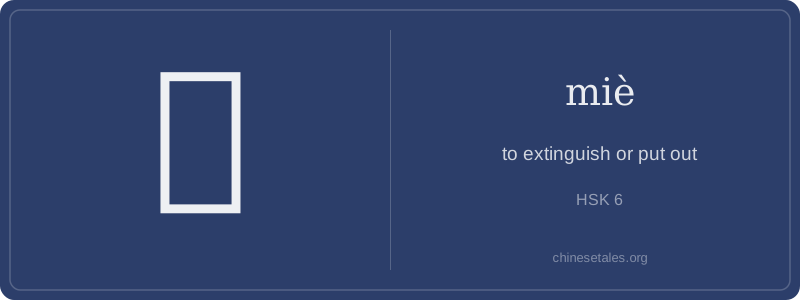
The earliest form of 灭 appears in late Warring States bamboo slips — not as a fire pictograph, but as 火 with a horizontal line (一) drawn *across* its top. That stroke wasn’t decorative: it was a ‘cover’ or ‘seal’, visually smothering the flames. Think of pressing a lid over a brazier — the fire isn’t gone yet, but its breath is cut off. Over centuries, the 火 radical simplified from its full 4-dot form (灬 in bottom variants) to the modern three-stroke 火, while the suppressing line hardened into a clean, authoritative横 (héng, horizontal stroke) — now the fifth and final stroke.
This visual logic shaped its meaning deeply: classical texts like the *Zuo Zhuan* used 灭 to describe states ‘extinguished’ by conquest — not merely defeated, but erased from the ritual and archival record. The character embodies ancient Chinese cosmology: fire symbolizes vitality and mandate; to 灭 it is to revoke cosmic legitimacy. Even Mencius wrote, ‘国之将亡,必有妖孽;火之将灭,必有余烬’ (‘When a state nears ruin, omens appear; when fire nears extinction, embers remain’) — linking the physical fading of flame to political collapse. The stroke across the fire remains a silent, stark metaphor for absolute cessation.
At its core, 灭 (miè) isn’t just ‘to put out a fire’ — it’s the *act of deliberate, irreversible suppression*: extinguishing flames, erasing hope, wiping out evidence, or even annihilating civilizations. It carries weight, finality, and often moral gravity. Unlike softer verbs like 消 (xiāo, 'to disappear gradually'), 灭 implies agency and force — someone *makes* something cease to exist.
Grammatically, 灭 is versatile: it functions as a transitive verb (e.g., 灭火 ‘extinguish fire’), appears in compound verbs (熄灭, 扑灭), and even forms abstract nouns like 灭亡 (‘annihilation’). Crucially, it rarely stands alone in modern speech — you’ll almost always see it paired: 熄灭 (xī miè), 扑灭 (pū miè), or 压灭 (yā miè). Learners often mistakenly use it bare in sentences like ‘I extinguish the light’ — but native speakers say 我关了灯 or 我把灯熄灭了, not *我灭了灯.
Culturally, 灭 echoes in classical phrases like 灭门 (‘family extermination’, a brutal legal punishment in imperial China) and modern political discourse like 灭绝 (‘genocide’). Its radical 火 reminds us this began with fire — yet today it governs metaphors far beyond combustion: 灭口 (‘eliminate a witness’), 灭迹 (‘destroy evidence’), even 灭绝师太 (a famously ruthless nun in martial-arts fiction). Beware: it’s never neutral — even 灭蚊 (‘kill mosquitoes’) subtly frames the act as decisive eradication, not gentle repelling.