滔
Character Story & Explanation
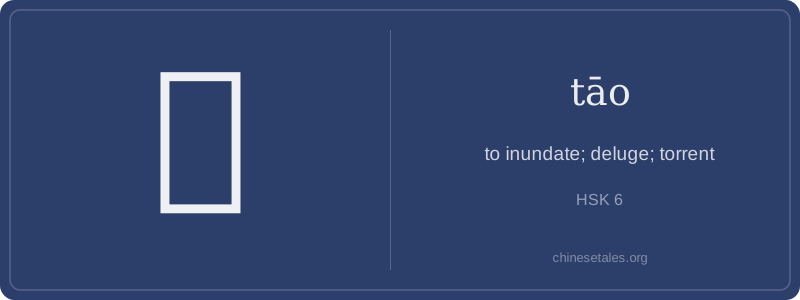
The earliest form of 滔 appears in bronze inscriptions as a combination of 水 (water, later simplified to 氵) and 舀 (yǎo, 'to scoop'). But here’s the twist: 舀 wasn’t just a phonetic clue — its original pictograph showed a hand holding a ladle dipping into water. Over centuries, the hand and ladle fused into the top-right component 亼 + 口 + 丿, evolving into the modern 韶-like shape (actually derived from 㠯 + 口). So visually, 滔 was born from the idea of *water being scooped up en masse* — implying volume, motion, and agency.
This visual logic shaped its meaning: by the Warring States period, 滔 appeared in the *Zuo Zhuan* describing rivers 'overflowing their banks with fury', and in the *Classic of Poetry*, where it evokes 'the Yellow River’s furious surge'. Unlike calm water characters like 河 or 海, 滔 always implies *loss of control*: water escaping containment, language escaping restraint, power escaping limits. Its radical 氵 anchors it to water, but its right side whispers *intentional force* — making it uniquely suited for metaphors of excess and moral rupture.
Imagine standing on a cliff as the Yangtze River swells after weeks of rain — not just rising, but *boiling*, surging, hurling itself over banks with unstoppable force. That’s 滔: it doesn’t mean ‘a lot of water’ — it means *water in violent, overwhelming motion*. It’s the roar before the flood, the moment the dam shudders. In Chinese, 滔 is almost never used alone; it lives in compounds like 滔滔 (tāo tāo) or 滔天 (tāo tiān), where it intensifies scale and drama — think 'torrential', 'boundless', or 'apocalyptic'. You’ll rarely see it in casual speech; it’s literary, poetic, often hyperbolic.
Grammatically, 滔 functions as an adjective or adverb in reduplicated form (滔滔) to describe unceasing flow — of water, words, or even emotions. For example, 滔滔不绝 (tāo tāo bù jué) literally means 'surging without stopping' and describes someone who talks nonstop — not just 'chatty', but *rhetorically unstoppable*. Learners often mistakenly use 滔 as a verb ('to flood') — but it’s never conjugated that way. No '滔了' or '滔过'; it’s always embedded in set phrases.
Culturally, 滔 carries moral weight: in classical texts, 滔天之罪 means 'crime so grave it reaches the heavens' — linking physical inundation to moral overflow. A common mistake? Confusing it with 波 (bō, 'wave') or 涛 (tāo, 'big wave'), which are more neutral and concrete. 滔 is about *force*, not form — it’s the energy behind the wave, not the wave itself.