浊
Character Story & Explanation
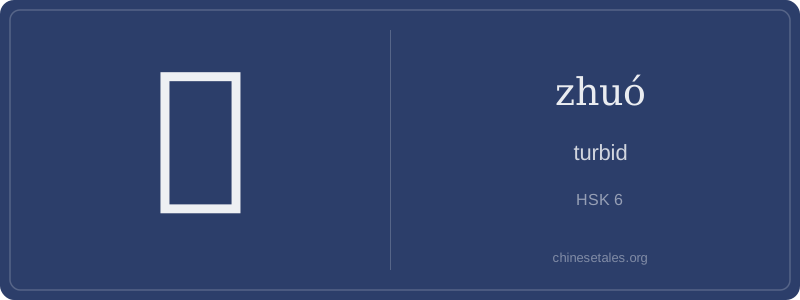
The earliest form of 浊 appears in bronze inscriptions as a combination of 水 (water, later simplified to 氵) and 虫 (insect/worm). Why a worm? Not literal filth — rather, ancient scribes visualized turbid water as churning with unseen life, sediment, and writhing particles. Over centuries, 虫 evolved into the right-hand component 石 (shí, stone) — not because stones cause cloudiness, but due to phonetic borrowing: 虫 (chóng) and 石 (shí) both approximated the ancient pronunciation *droɡ, and scribes gradually standardized the sound-bearing element. By the Han dynasty, the character had stabilized as 氵+石 — nine strokes total, with the three-dot water radical anchoring its aquatic essence.
This visual shift from ‘worm-water’ to ‘stone-water’ didn’t erase meaning — it deepened it. Stone suggests weight, density, immovability: turbidity isn’t fleeting dirt, but *settled heaviness*. Classical texts like the Zhuangzi use 浊 to contrast with 清 (qīng, clarity): ‘The sage remains unmoved in the midst of 浊世 (turbid age)’. Even today, when environmentalists decry polluted rivers, they invoke this ancient image — not of trash, but of water burdened by what cannot rise or settle peacefully.
Think of 浊 (zhuó) as the Chinese cousin of 'muddy' in English — but with a philosophical twist. It doesn’t just describe cloudy water; it evokes moral and sensory murkiness: turbid rivers, muddled thinking, or even coarse, unrefined speech. Unlike English ‘turbid’ (a stiff, scientific word), 浊 is alive in both classical poetry and modern critique — e.g., describing polluted air (浊气) or spiritual confusion (浊世). Its core feeling is *unclarified*, *unsettled*, *weighted down* — never neutral.
Grammatically, 浊 functions almost exclusively as an adjective (never a verb), often modifying nouns directly: 浊水 (turbid water), 浊音 (voiced consonants — literally 'heavy/murky sounds'). Crucially, it’s rarely used predicatively without support: you’d say 这水很浊 (this water is turbid), but not *这水浊 — that bare structure feels archaic or poetic. Learners often overuse it like English ‘dirty’, but 浊 implies *inherent opacity*, not surface grime (that’s 脏).
Culturally, 浊 carries Daoist and Buddhist weight: in the Tao Te Ching, clarity (清) and turbidity (浊) are complementary forces — ‘When the dust settles, the murky becomes clear’ (孰能浊以静之徐清?). Mistaking 浊 for mere ‘dirt’ misses its metaphysical duality. A common error? Confusing it with 拙 (zhuō, ‘clumsy’) — same sound, totally different meaning and shape. Also, avoid pairing it with verbs like ‘make’ — Chinese says 使水变浊 (make water become turbid), not *使水浊.