滥
Character Story & Explanation
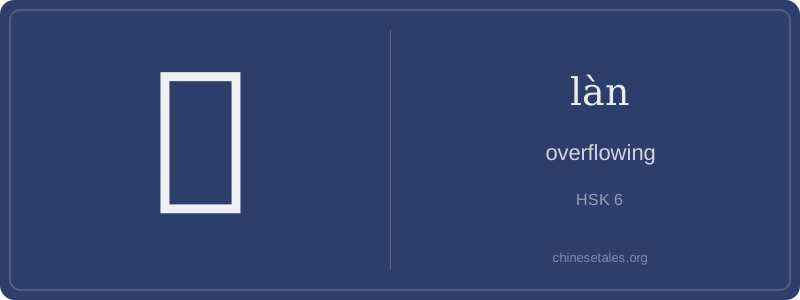
The earliest form of 滥 appears in bronze inscriptions as a flowing river (氵) beside a complex phonetic component that resembled a bent person holding a tool near water—possibly depicting someone recklessly diverting or breaching a channel. Over time, the right side simplified into 监 (jiān, 'to supervise'), but crucially, not for meaning: it was borrowed purely for sound (làn ≈ jiān in Old Chinese), while the water radical 氵 anchored the core idea of uncontrolled flow. The modern 13-stroke shape solidified by the Han dynasty—three dots for water, then 监 neatly stacked, visually echoing containment failing under pressure.
This visual tension—water + 'supervision' that fails—shaped its semantic evolution. In the *Zuo Zhuan*, 滥 described rivers flooding due to neglected dikes ('the duke failed to 滥 his duties'—i.e., let flood control lapse). By the Tang, it broadened to moral excess: Bai Juyi criticized officials who '滥授官职' (làn shòu guānzhí, 'recklessly conferred official posts'). The character’s genius lies in how its structure enacts its meaning: water (氵) overwhelming the very symbol of oversight (监)—a silent lesson in consequences.
At its heart, 滥 (làn) isn’t just about water spilling over—it’s about *excess that breaks natural or moral boundaries*. Think of a dam bursting not from strength, but from carelessness or greed. That’s the visceral feeling: uncontrolled, unjustified, even reckless overflow—whether of water, words, praise, or power. In modern usage, it almost never stands alone; it’s the sharp edge in compound words like 滥用 (lànyòng, 'to abuse') or 滥发 (lànfā, 'to issue recklessly'). You’ll rarely say 'the river is 滥'—instead, you say 'they 滥用 authority' or 'prices 滥涨 (lànzhǎng, 'skyrocket irrationally').
Grammatically, 滥 functions almost exclusively as an adverbial modifier before verbs—it tells *how* something is done: excessively, indiscriminately, without restraint. It carries strong negative judgment, so using it neutrally (e.g., 'he eats a lot') would sound bizarre; instead, it’s 'he 滥吃 junk food' (indiscriminate, harmful overconsumption). Learners often mistakenly use it like 'very' or 'too', but 滥 implies moral or systemic failure—not mere degree.
Culturally, 滥 echoes ancient Daoist and Confucian warnings against excess: the *Dao De Jing* says 'when wealth and honor lead to arrogance, it is the beginning of ruin'—that’s the spirit of 滥. A classic trap? Confusing it with 泛 (fàn, 'to spread widely'), which is neutral (e.g., 泛读 fàndú, 'extensive reading'); 滥 always adds a tinge of disapproval. Also, avoid pronouncing it làn like 'lan'—it’s a falling tone, sharp and abrupt, mirroring the suddenness of overflow.