溅
Character Story & Explanation
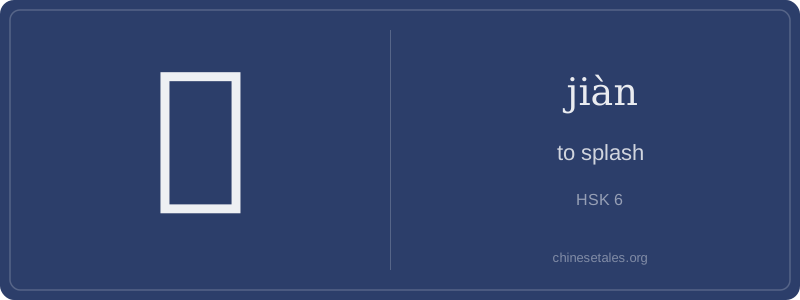
The earliest form of 溅 appears in seal script as a combination of 氵 (water radical) and 贱 (jiàn, meaning 'low' or 'cheap') — but this isn’t about value. 贱 here serves purely as a phonetic component (both 溅 and 贱 share the jiàn reading), while the three dots of 氵 visually anchor it to liquid. Over time, the right-hand side simplified from the full 賤 (which had 貝, a shell representing currency) to the modern 贱 — losing the 貝 but keeping the phonetic cue and the downward stroke that subtly echoes water rebounding off ground.
This character never appeared in oracle bone inscriptions — it emerged later, during the Warring States period, precisely because Chinese needed a word for *impact-driven scattering*. Its first major literary appearance is in the Northern Dynasties’ Mulan Poem, where ‘鸣溅溅’ (míng jiàn jiàn) mimics the rapid, staccato gurgle of fast-flowing river water — not just sound, but the visual rhythm of droplets leaping and colliding. The shape itself tells the story: the three water dots on the left pulse like droplets mid-air, while the right side’s descending strokes mimic downward force followed by energetic rebound — a perfect graphic echo of physics in ink.
Imagine standing barefoot on wet cobblestones after a summer thunderstorm — suddenly, a passing taxi hits a puddle and jiàn! A cold, sharp spray of water explodes upward, soaking your ankles. That explosive, involuntary, slightly chaotic burst is the soul of 溅: it’s not gentle dripping or steady flowing — it’s sudden, forceful, directional splashing, often with energy, noise, and consequence. In Chinese, 溅 is almost always used as a verb (rarely as a noun), and it demands motion + impact: water hitting a surface, blood spattering, tears bursting forth.
Grammatically, 溜 is *not* used alone in formal writing — you’ll nearly always see it reduplicated (溅溅) for onomatopoeic effect, or paired with directionals like 溅起 (splash up), 溅落 (splash down), or 溅到 (splash onto). Learners often mistakenly use it like ‘spill’ (洒) — but 溅 implies *recoil*, *rebound*, or *scattering*; 洒 is passive dispersion. You splash *onto* something (溅到墙上), not *into* it. Also, while English says ‘splash water’, Chinese usually omits the object: 他一踢,水就溅起来了 (Tā yī tī, shuǐ jiù jiàn qǐlái le) — the water does the splashing *by itself*.
Culturally, 溅 carries visceral weight — in classical poetry, 溅溅 describes rushing streams (like in the Mulan Poem: ‘不闻爷娘唤女声,但闻黄河流水鸣溅溅’), evoking both sound and turbulent motion. Modern usage leans dramatic: blood 溅, tears 溅, even metaphorical sparks 溅 from an argument. A common error? Using it for raindrops falling — no! Rain falls (下); only when drops *hit* a surface and scatter does 溅 apply.