濒
Character Story & Explanation
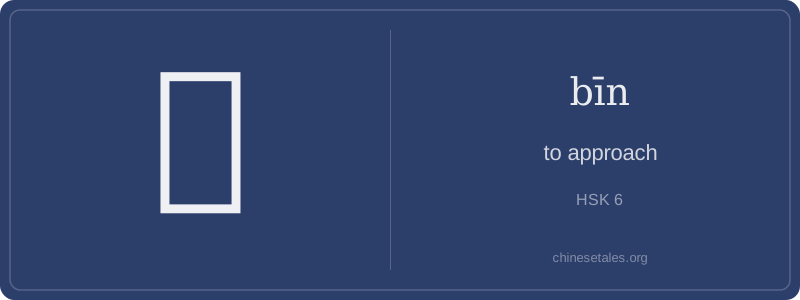
The earliest form of 濒 appears in seal script (c. 3rd century BCE), where it clearly shows three water drops (氵) on the left and a complex right side derived from 频 (pín, 'frequent; repeated'). But crucially, that right component originally depicted a person bowing repeatedly — head dipping low, again and again, like waves lapping at a shore. Over centuries, the bowed figure simplified into the modern 频 shape, while the water radical emphasized the setting: coastal edges, riverbanks, places where land meets water — the ultimate natural threshold. Stroke-by-stroke, it evolved from fluid pictoriality (three distinct water droplets + a kneeling figure) into today’s crisp 16-stroke structure: 氵 (3 strokes) + 频 (13 strokes), with the top of 频 becoming the 'book' radical (彐) and the bottom the 'step' element (歩).
This visual logic directly shaped its meaning: to stand where land and water meet is to stand where stability ends and flux begins — hence 濒 came to mean 'to be at the boundary of irreversible change.' Classical texts rarely used it alone; instead, it appeared in compounds like 濒海 (bīn hǎi, 'coastal') in the *Book of Han*, reinforcing its geographic origin. By the Tang dynasty, poets began using 濒 metaphorically — Du Fu wrote of hearts 濒死 (bīn sǐ, 'on the verge of death'), extending the shoreline imagery into emotional and existential realms. The water didn’t just surround; it threatened to submerge — and that tension remains core to its meaning today.
Think of 濒 (bīn) as the quiet, urgent whisper before a threshold — not quite crossing, but already feeling the edge. It doesn’t mean ‘to reach’ like 到 or ‘to arrive’ like 抵达; it means *to approach so closely that danger, change, or inevitability is palpable*. You’ll almost always see it in formal, literary, or scientific contexts: 濒危 (bīn wēi, 'critically endangered'), 濒临 (bīn lín, 'on the verge of') — never in casual speech like 'I’m approaching the bus stop.' Its grammatical role is strictly as a verb meaning 'to be on the brink of X,' and it’s nearly always followed by another verb or noun (e.g., 濒临崩溃, 濒危物种). Skip the literal 'approach' translation — this character carries gravity, tension, and consequence.
Learners often misread 濒 as 'near' or 'close to' and slap it into everyday sentences ('我濒临超市'), which sounds bizarre — like saying 'I’m on the verge of the supermarket.' Nope. It’s reserved for high-stakes proximity: extinction, collapse, breakthrough, or existential risk. Also, note its tone: bīn (first tone, flat and firm), not bǐn (third tone) — mispronouncing it risks confusion with 嫔 (a palace lady) or even 槟 (betel nut).
Culturally, 濒 evokes classical restraint: rather than shouting 'disaster!' it quietly positions you at the water’s edge — literally, since its radical is 氵 (water). That water isn’t soothing; it’s rising, encroaching, unstoppable. In modern usage, it’s become the go-to character for China’s environmental reports and policy white papers — where every 濒危 species is a diplomatic and ethical statement. Mastering it means mastering nuance: not movement toward something, but the charged stillness *right before* the wave breaks.