焰
Character Story & Explanation
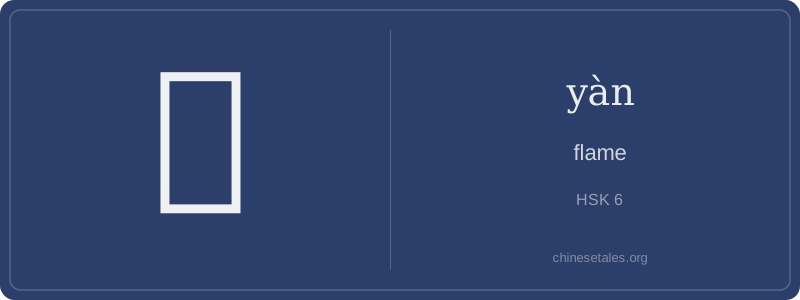
The earliest form of 焰 appears in bronze inscriptions as a combination of 火 (a stylized pictograph of flames rising from a base) plus 厶 (sī), an ancient variant of 旡 (jì), meaning ‘to lack breath’ or ‘to be exhausted’ — but here, it functions phonetically. Over time, 厶 evolved into 乚 (yǐn), then merged visually with 又 (yòu) to form the right-hand component (now written as in simplified forms). By the Han dynasty, the structure stabilized: left-side 火 (the semantic anchor) + right-side (phonetic, approximating yàn). Crucially, the top two dots of 火 remain distinct — they’re not merged like in 灯 — preserving the image of twin tongues of flame.
This visual logic shaped its meaning: while 火 is fire as phenomenon or resource, 焰 specifically captures the *visible, radiant manifestation* — the part that leaps, flickers, and illuminates. In the Classic of Poetry, ‘焰焰’ (yàn yàn) describes the fierce, unquenchable blaze of righteous anger; in Tang poetry, Li Bai uses 焰 to personify celestial energy. Even today, its shape whispers motion: the three rising strokes of 火 + the curving, upward-sweeping right side mimic flame’s restless ascent — no static symbol, only kinetic heat made visible.
Think of 焰 (yàn) not as just 'flame' but as the *living, leaping essence* of fire — the bright, hot, upward-rushing part you see dancing above the logs, not the dull ember or the smoke. It’s visceral and dynamic: in classical texts, it evokes divine wrath or spiritual radiance; in modern usage, it often carries poetic, dramatic, or even metaphorical weight (e.g., 烈焰 ‘fierce flame’ for overwhelming passion or crisis). Unlike the neutral 火 (huǒ), which can mean fire as substance, tool, or element, 焰 is inherently *visual and intense* — you almost hear the crackle when you say it.
Grammatically, 焰 is almost never used alone. It appears in compounds (like 火焰 or 余焰) or as the noun in descriptive phrases — think of it like English ‘blaze’ or ‘gout’: precise, vivid, and slightly literary. Learners sometimes mistakenly use it where 火 fits better (e.g., saying *焰灾* instead of 火灾 for ‘fire disaster’ — a red flag to native ears). Also, it’s rarely a verb or adjective: you don’t ‘flame’ something — you ignite it with 火, and describe its glow with 焰.
Culturally, 焰 ties into Daoist and Buddhist imagery — the ‘flame of wisdom’ (智慧之焰) that burns away ignorance, or the ‘eternal flame’ (不灭之焰) symbolizing enduring spirit. Watch out for tone confusion too: yàn (4th tone) sounds sharp and abrupt — like a spark snapping — unlike yān (1st tone, ‘smoke’) or yǎn (3rd tone, ‘to extend’). This tonal punch reinforces its energetic, urgent feel.