熏
Character Story & Explanation
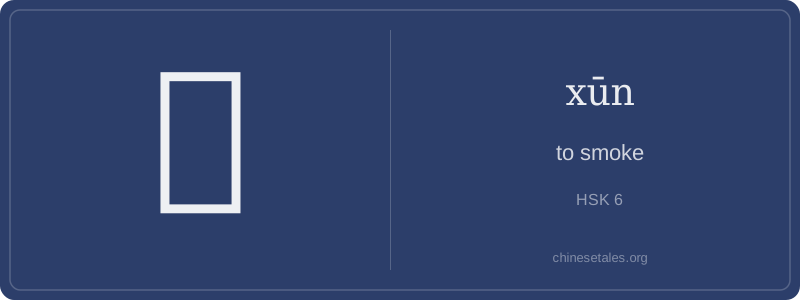
The earliest form of 熏 appears in bronze inscriptions as a vivid pictograph: two stacked 'fire' symbols (灬) beneath a stylized 'cage' or 'cover' (the top part, now written as 黑 minus the four dots). This wasn’t abstract — it depicted actual smoke rising *upward under confinement*, like herbs smoldering beneath a covered brazier. Over centuries, the upper component evolved from a pictorial cage into the character 黑 (hēi, black), not because it means 'black', but because smoke visibly darkens surfaces — linking effect to symbol. The four-dot fire radical (灬) stayed firmly at the bottom, anchoring its elemental nature.
By the Han dynasty, 熏 had solidified into its modern shape — still visually whispering 'contained fire + rising smoke'. Classical texts like the Rites of Zhou mention 熏香 (xūn xiāng, fumigating incense) for exorcising evil qi, while Tang poets used it metaphorically: '烟熏泪眼' (yān xūn lèi yǎn — smoke-smudged tearful eyes) evoking sorrow’s slow, blurring weight. Its visual duality — blackness above, fire below — perfectly mirrors its dual role: preserving food and purifying souls, both through patient, invisible change.
At its heart, 熏 is all about slow, pervasive transformation by smoke — not fire’s flash, but smoke’s stealthy seep. Think of hanging cured ham in a cedar shed or incense curling through a temple: it’s gentle, cumulative, and deeply sensory. Unlike 烧 (shāo, to burn) or 烤 (kǎo, to roast), which imply direct heat, 熏 always carries that atmospheric, enveloping quality — the smoke doesn’t just touch; it impregnates.
Grammatically, 熏 is wonderfully flexible: it works as a transitive verb (e.g., 熏鱼 — smoked fish), a causative verb (熏黑 — 'to blacken *by smoking*'), and even in passive or resultative constructions (被熏得睁不开眼 — 'so smoked I couldn’t open my eyes'). Learners often misplace it as a simple synonym for 'smell' — but 熏 is never neutral: it’s always an active, often intentional, process with physical consequence. You don’t 'xūn a scent'; you ‘xūn tea leaves’ or ‘xūn your lungs’ (in a bad way!).
Culturally, 熏 bridges ritual and craft: from ancient Zhou dynasty fumigation rites (to purify spaces and people) to modern Hangzhou’s famous 熏青豆 (smoked green beans), it’s tied to preservation, purification, and subtle flavor infusion. A classic pitfall? Using 熏 where 香 (xiāng, fragrant) belongs — confusing the *process* of smoking with the *result* of smelling nice. Remember: 熏 is the action; 香 is the aroma.