爆
Character Story & Explanation
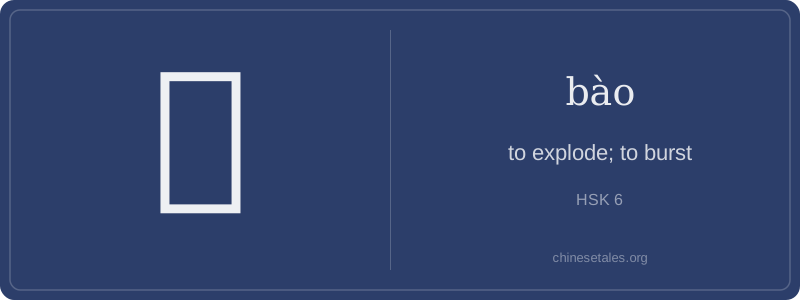
The earliest form of 爆 appears in bronze inscriptions as a combination of 火 (fire) on the left and a phonetic component resembling 曝 (bào, ‘to dry in sun’) on the right — but with a crucial twist: the right side originally included a ‘rice grain’ (米) shape, suggesting grains popping under heat. Over centuries, the rice grain morphed into the modern 曱 (a stylized ‘splitting’ shape), while the fire radical stayed fiercely literal. By the Han dynasty, the character had stabilized into its current 19-stroke form: 火 + 曱 + 攵 (‘hand holding a stick’), subtly implying *human action triggering rupture* — not just natural combustion, but an act that provokes explosion.
This visual logic shaped its semantic journey. In classical texts like the Shuōwén Jiězì, 爆 was defined as ‘sudden fire breaking forth’, used for crackling firewood or gunpowder ignition. By the Ming dynasty, it expanded metaphorically: in novels like Journey to the West, it described Sun Wukong’s rage ‘bursting forth like ignited gunpowder’. Today, its fire-rooted violence powers digital-age idioms — the same ancient spark now lights up Weibo trends and stock market crashes. The character hasn’t changed; our explosions have just gone viral.
Imagine a street food vendor in Chengdu, wok blazing, tossing dried chilies into scorching oil — BOOM! — a sudden, violent burst of flame, smoke, and aroma. That’s 爆 (bào): not just ‘explode’ like a bomb, but a visceral, sensory explosion — sudden, intense, irreversible, and often accompanied by heat, sound, or transformation. It conveys *uncontrolled release*: pressure snapping, emotions erupting, markets crashing, or viral content going supernova.
Grammatically, 爆 is almost always a verb, but it rarely stands alone. You’ll see it in compound verbs like 爆发 (bàofā, ‘to break out’) or as the first element in vivid resultative constructions: 爆红 (bàohóng, ‘to explode-red’ = go massively viral), 爆炸 (bàozhà, ‘explode-shatter’ = detonate). Crucially, it’s *not* used for gentle bursting (that’s 裂 or 撕); nor does it take aspect markers like 了 easily unless paired — you say ‘他突然爆发了’ (tā tūrán bàofā le), not ‘他爆了’. Learners often overuse it like English ‘explode’, forgetting its cultural weight: in Chinese, an ‘explosion’ implies loss of control, social consequence, or irreversible change — never just loud noise.
Culturally, 爆 carries high emotional voltage: 爆款 (bàokuǎn) isn’t just ‘bestseller’ — it’s a product that *shatters expectations*; 爆料 (bàoliào) means ‘spill explosive intel’, not just ‘reveal’. And watch out: using 爆 to describe someone’s anger (e.g., ‘他爆了’) sounds cartoonish or slangy — native speakers prefer 发火 or 暴怒. The character demands respect: it’s the linguistic equivalent of striking a match near gasoline.