爽
Character Story & Explanation
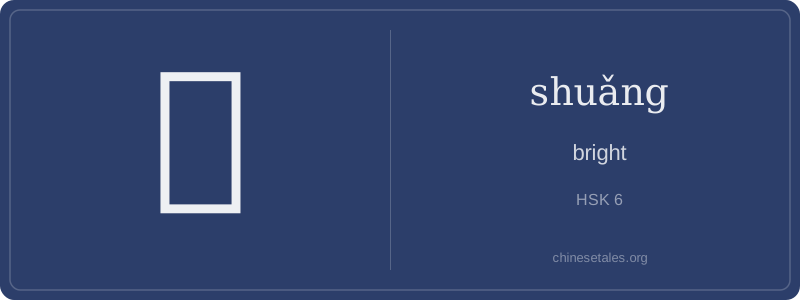
The earliest form of 爽, found on Shang dynasty oracle bones, looked like four ‘X’-shaped marks (爻) arranged symmetrically around an empty center — resembling open windows in a square room, or perhaps sunbeams crossing in clear air. Each ‘X’ (爻) originally represented intersecting lines — cosmic patterns, divination symbols, or simply ‘crossing paths’. The emptiness at the center was key: it signified openness, ventilation, unobstructed space — the visual essence of ‘brightness’ as airy clarity, not glare.
Over centuries, the four ‘X’s solidified into the modern 爻 radical stacked top-and-bottom, while the central void remained implied by the symmetrical spacing — no stroke touches the center. In the Shuōwén Jiězì (2nd c. CE), Xu Shen defined it as ‘bright, clear, unblocked’ (明也,一曰淸也), linking it to both light and psychological relief. By the Tang, poets like Li Bai used 爽 to describe the exhilarating chill of high mountains (‘清风拂面,神清气爽’), cementing its dual sensory-emotional resonance — a meaning unchanged for 2,500 years.
At its core, 爽 (shuǎng) isn’t just ‘bright’ in the literal sense — it’s the visceral feeling of cool clarity: crisp mountain air, a sudden mental breakthrough, or the relief after confessing a secret. It conveys lightness, refreshment, and unburdened ease — almost always tied to sensory or emotional release. Think less ‘sunlight’ and more ‘aha!’, ‘ahhh…’, or ‘whew!’.
Grammatically, 爽 shines as an adjective (e.g., 爽快 shuǎngkuài ‘frank and decisive’) and as a verb meaning ‘to enjoy thoroughly’ — but only in colloquial, often playful contexts (e.g., 爽了 shuǎng le, ‘I’m all set!’ or ‘That hit the spot!’). Crucially, it *cannot* be used predicatively like 漂亮 or 好 without support: you don’t say *‘他很爽’ to mean ‘He is bright’ — that would mean ‘He’s feeling great/relieved,’ not ‘He is luminous.’ Learners often overextend it into formal or literal brightness contexts where 明亮 or 清澈 belong.
Culturally, 爽 carries a delightful informality — it’s the character of post-work beers, satisfying revenge plots in wuxia novels, and Gen-Z slang like 爽文 (shuǎngwén, ‘wish-fulfillment fiction’). Its power lies in emotional authenticity, not objective description. A classic trap? Confusing it with 爽朗 (shuǎnglǎng, ‘cheerful and forthright’) — where 爽 modifies, not defines, the tone. Also, note: it’s rarely used alone in writing; it thrives in compounds and exclamations.