牲
Character Story & Explanation
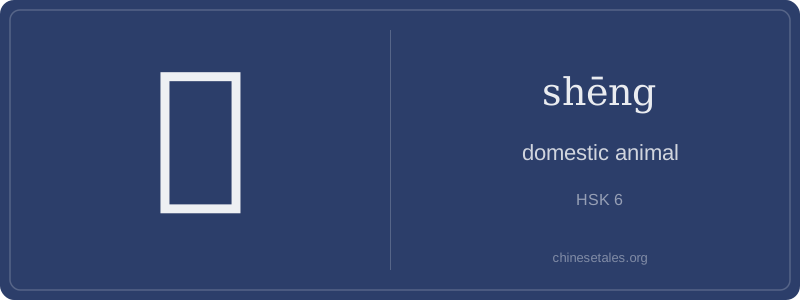
The earliest form of 牲 appears in late Shang oracle bones as a pictograph of an ox (牛) with a distinct marking — often a vertical stroke or dot on its flank — indicating ritual selection. By the Western Zhou bronze script, this evolved into a clear left-right structure: the radical 牛 (ox) on the left, and 生 (shēng, ‘life, birth’) on the right. But here’s the twist: 生 wasn’t chosen for meaning alone — its shape (a sprout emerging from soil) visually echoes the upright posture and vitality expected of a ritually fit animal. Over centuries, the ox radical simplified, and 生 lost its top horizontal stroke, solidifying into today’s 9-stroke form.
This visual pairing — 牛 + 生 — tells a deeper story: not just ‘living ox’, but ‘an animal whose life is consecrated’. In the Zuo Zhuan, we read ‘国之大事,在祀与戎’ (‘The state’s greatest affairs are sacrifice and warfare’), and 牲 stood at the heart of the first. Confucius emphasized that proper ritual required ‘色纯’ (pure color) and ‘体全’ (intact body) in the 牲 — flaws invalidated the entire ceremony. So 牲 isn’t passive livestock; it’s a living symbol, chosen, groomed, and elevated — its very shape a silent vow between ruler, people, and heaven.
Picture a ritual scene in Shang dynasty bronze inscriptions: a sturdy ox, head lowered, marked for sacrifice — not as food, but as sacred offering to ancestors or heaven. That’s the soul of 牲 (shēng): it doesn’t just mean ‘domestic animal’ — it carries the solemn weight of *ritual purity*. This character is never used casually for pets or livestock; it’s reserved for animals selected and prepared for ceremonial use — think ‘sacrificial beast’, not ‘farm cow’. In classical texts like the Book of Rites, 牲 appears with precise specifications: a black ox for earth deities, a red one for fire — color, age, and flawlessness all mattered.
Grammatically, 牲 is almost always noun-only and highly formal. You won’t say ‘my 牲’ or ‘the 牲 runs fast’. It appears in fixed compounds (牲畜, 牺牲) or as the head noun in phrases like 牲牢 (shēng láo, ‘sacrificial animals and pens’) or in classical syntax: ‘择牲以告’ (zé shēng yǐ gào, ‘select the sacrificial beast to report [to spirits]’). Learners often mistakenly use it where 家畜 (jiāchù, ‘livestock’) or 畜 (xù, ‘to raise animals’) would be natural — a subtle but jarring error, like calling your neighbor’s golden retriever ‘a ritual offering’.
Culturally, 牲 is inseparable from ancient Chinese cosmology: animals weren’t merely property, but mediators between human and divine realms. Its radical 牛 (niú, ‘ox’) isn’t decorative — it signals the archetype of sacrificial strength and docility. Modern usage is mostly literary or historical, but its echo lives on in 牺牲 (xīshēng, ‘sacrifice’), where the semantic core remains: giving up something precious for a higher purpose. The tone mark in shēng (first tone) sounds crisp and solemn — fitting for a word that once echoed in temple courtyards.