牺
Character Story & Explanation
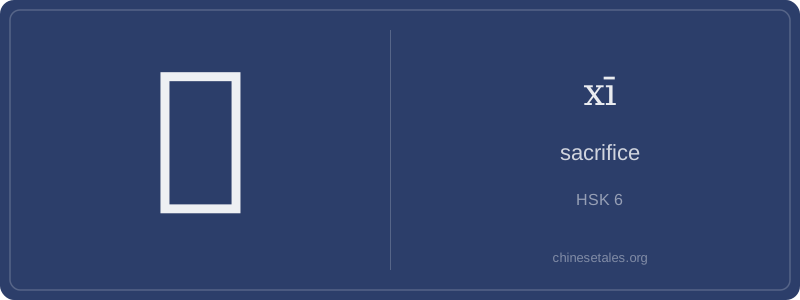
Oracle bone inscriptions show 牺 as a vivid pictograph: an ox (牛) with stylized horns and hooves, often accompanied by a mark indicating ritual purity — sometimes a dot or stroke near the head. By the bronze script era, the left side had standardized into the 牛 radical (with the ‘tail’ stroke simplified), while the right side evolved from a symbol representing a ceremonial vessel or altar into the shape of 西 — not because it meant ‘west’, but because scribes borrowed that graph for its sound and visual simplicity. Over centuries, clerical script smoothed the curves, and regular script (today’s form) locked in the 10-stroke balance: four strokes for 牛 (as a left-component variant), six for 西 — no extra flourishes, all purposeful.
This character’s meaning deepened alongside China’s ritual statecraft. In the *Rites of Zhou*, 牺 referred specifically to animals raised for three years in sacred pens, inspected for blemishes before being led westward to altars — linking the ‘west’ component to actual ritual procession. Mencius later used 牺牲 metaphorically to critique rulers who sacrificed people like livestock, embedding ethical weight into the term. Even today, when politicians speak of ‘sacrificing personal interests’, the ghost of that ritually pure ox still walks behind the word — quiet, heavy, and unmistakably Chinese.
At its heart, 牺 (xī) is all about ritual sacrifice — not just any offering, but a carefully selected, unblemished animal (usually an ox or sheep) presented to ancestors or deities in ancient Chinese rites. The character’s radical 牛 (niú, ‘ox’) immediately anchors it in the animal world, while the right side 西 (xī, ‘west’) isn’t geographical here — it’s a phonetic clue (both 牺 and 西 share the xī sound) that also subtly evokes ritual directionality (west was associated with death and the afterlife in early cosmology). This isn’t a casual word: you’ll almost never use it alone — it only appears in compounds like 牺牲 (xīshēng, ‘sacrifice’) or 牺牲品 (xīshēngpǐn, ‘sacrificial victim’).
Grammatically, 牺 never stands solo as a verb — unlike English ‘to sacrifice’, Chinese uses verbs like 献 (xiàn, ‘to present’) or 牺牲 (xīshēng) as a transitive verb or noun. Learners often mistakenly try *xī* as a standalone verb (*‘I xī my time’*), but that’s ungrammatical; it must be 牺牲. Also, note that modern usage has broadened metaphorically: 牺牲 can mean ‘to give up something valuable for a greater cause’ — e.g., sacrificing sleep for exams — but the tone remains solemn, never trivial.
Culturally, this character carries ancestral gravity. In Confucian texts like the *Analects*, proper sacrifice (including correct 牺 animals) signaled moral integrity and social harmony. A common learner trap is overextending it to Christian or Western religious contexts — but 牺 is deeply tied to *Chinese* ritual cosmology, not generic ‘offering’. Using it outside formal, historical, or high-register contexts (e.g., journalism, literature, political rhetoric) sounds archaic or jarringly solemn.