犯
Character Story & Explanation
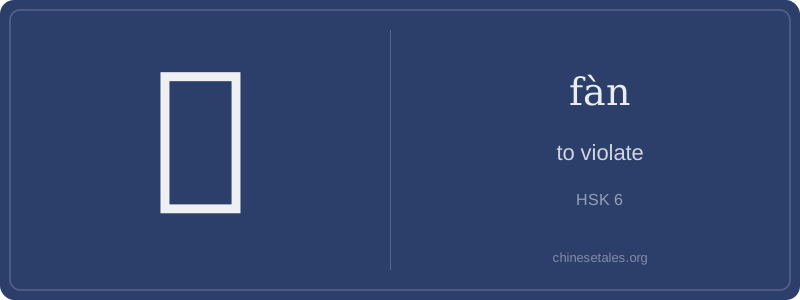
The earliest form of 犯 appears in bronze inscriptions as a combination of 犭 (quǎn, 'dog') and 范 (fàn, 'mold; pattern') — but wait, that’s not quite right! Actually, the right side evolved from 口 (kǒu, 'mouth') + 凵 (qūn, 'a pit or enclosure'), later stylized into 范’s top and bottom. The left 犭 hints at animal-like impulsiveness or danger — think of a dog lunging past its leash. Over centuries, the right side simplified: the mouth and pit merged visually into the modern 范-like shape, losing its pictorial clarity but keeping its phonetic role (fàn).
This visual duality — beastly impulse + rigid mold — perfectly mirrors its semantic journey. In the Zuo Zhuan, 犯 describes ministers who 'dared to oppose' the ruler (e.g., 犯颜直谏), where ‘violating’ wasn’t criminal but morally courageous. Later, under imperial legal codes, it hardened into its modern punitive sense. The character’s five strokes — swift, angular, unyielding — still echo that moment of crossing the line: one stroke for the dog’s leap, four for the boundary shattered.
At its heart, 犯 (fàn) isn’t just ‘to violate’ — it’s the sharp, deliberate act of crossing a line you *know* is there: a law, a taboo, a boundary of trust, or even a social expectation. It carries weight and intention; you don’t accidentally 犯 a crime — you commit it. Unlike generic verbs like 做 (do) or 有 (have), 犯 always implies transgression against something established and authoritative.
Grammatically, 犯 is almost always transitive and appears in formal, legal, or moral contexts — never in casual speech like ‘I forgot my keys’. You say 犯法 (fàn fǎ, 'violate the law'), 犯规 (fàn guī, 'break the rules'), or 犯忌 (fàn jì, 'violate a taboo'). Crucially, it rarely takes aspect particles like 了 or 过 directly — instead, you’d say 他犯了罪 (tā fàn le zuì) — note how 犯 itself stays unchanged while the object (罪) and particle (了) do the heavy lifting.
Culturally, 犯 reflects China’s deep-rooted emphasis on harmony, hierarchy, and consequence: to 犯 is to disturb balance, inviting retribution or loss of face. Learners often mistakenly use it for minor oversights ('I violated the schedule' → no, use 迟到 or 打乱); reserve 犯 for serious, rule-anchored breaches. Also beware — it’s never used reflexively (no *犯自己*) and never with abstract feelings ('violate love' makes zero sense in Chinese).