狈
Character Story & Explanation
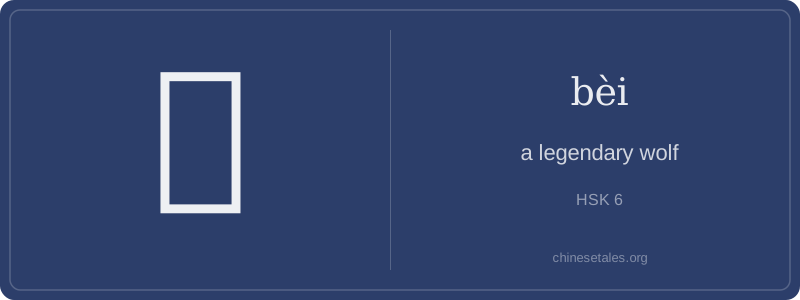
The earliest trace of 狈 appears not in oracle bones—but in Tang dynasty bestiaries and Song-era commentaries, because it was *invented* as a literary device. Visually, it’s a masterclass in semantic economy: the left radical 犭 (quǎn, ‘dog’ variant) signals animalhood, while the right side 匕 (bǐ) — originally a pictograph of a ritual spoon or bent figure — was repurposed to suggest a twisted, helpless posture. Stroke by stroke: dot (丶), short slant (丿), curved hook (㇁), then three lines forming 匕—two short strokes framing one long downward stroke, mimicking a hunched, off-balance silhouette.
By the Ming dynasty, 狈 had crystallized in texts like *Strange Tales from a Chinese Studio*, always paired with 狼. The pairing wasn’t arbitrary: 狼 represented raw power; 狈, dependency and guile. Their union became shorthand for toxic collaboration—so much so that ‘狼狈’ entered everyday speech as a compound adjective describing *anyone* flustered, exposed, or undone. Crucially, the character’s visual simplicity (just 7 strokes!) belies its conceptual weight: 匕 looks like a fallen person, and 犭 binds it to the animal realm—making 狈 a glyph of vulnerability weaponized by narrative.
Picture this: a creature so legendary it doesn’t exist in zoos—only in folklore and idioms. 狈 (bèi) isn’t just ‘a wolf’; it’s the mythical, crippled wolf said to be born with permanently bent hind legs, forcing it to ride on the back of a wolf to hunt. That eerie symbiosis is baked into its very essence—and into how Chinese speakers use it today. You’ll almost never see 狈 alone in modern speech; it’s nearly always paired with 狼 (láng) as 狼狈 (lángbèi), meaning ‘in a desperate, disheveled, or humiliated state’. Think of someone caught red-handed, scrambling over furniture to hide—their posture *is* 狼狈.
Grammatically, 狈 functions exclusively within compounds—never as a standalone noun or verb. Learners sometimes try to say ‘a bèi’ like ‘a wolf’, but that’s unnatural; even classical texts treat it as an inseparable half of a dyad. Its tone (bèi, fourth tone) echoes the abruptness of downfall—think of the sharp drop in pitch mirroring a stumble. And yes, it’s HSK 6 not because it’s frequent, but because mastering idiomatic nuance like 狼狈为奸 (lángbèi wéi jiān, ‘wolves and bèi collude’ → ‘crooks in cahoots’) separates advanced learners from fluent thinkers.
Culturally, 狈 carries heavy irony: though described as physically disabled, it’s portrayed as cunning, even sinister—making 狼狈 a richly layered term for moral and physical collapse. A common mistake? Assuming it’s related to real canids like 狗 (gǒu, dog) or 狐 (hú, fox). Nope—it’s purely mythic. Its power lies in absence: no bones, no fossils—just seven strokes and centuries of collective imagination whispering, ‘Don’t get caught like that.’