琢
Character Story & Explanation
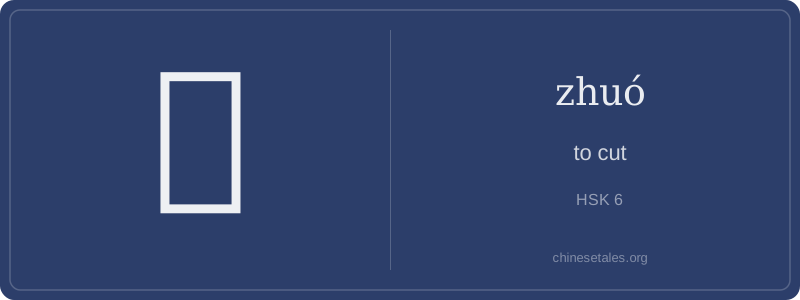
The earliest form of 琢 appears in bronze inscriptions as a pictograph combining two key elements: a piece of jade (the '王' radical, originally 玉 — jade — simplified over time) on the left, and on the right, a hand holding a tool — often depicted as a chisel or knife with serrated edges. Over centuries, the jade component standardized into the '王' radical (a visual shorthand for 'jade-related'), while the right side evolved from a complex tool-hand glyph into today’s 石 (shí, stone) — not because stone is involved, but because early jade-carving tools were made of harder stone like nephrite or quartz. The 12 strokes now precisely map that ancient workshop scene: three horizontal lines for jade’s layered luster, then nine strokes building the chiseling motion.
This character’s meaning never strayed far from its origin — unlike many characters that drifted semantically. From oracle bone times through the Han dynasty, 琢 consistently meant 'to carve jade'; by the Tang and Song dynasties, scholars extended it metaphorically to intellectual and moral refinement. Su Shi wrote of poetry needing '雕琢' (diāozhuó) — 'carving and polishing' — and Zhu Xi used 琢 to describe how sages shape their hearts. Even today, when Chinese parents urge their children to '好好琢磨', they’re invoking millennia of craftsmanship — asking them not just to think, but to *sculpt their thoughts like jade.*
At first glance, 琢 (zhuó) feels like a quiet, refined character — but don’t be fooled. Its core meaning isn’t just 'to cut' in the blunt, physical sense; it’s specifically *to carve or polish jade* — a slow, deliberate, skilled act of refinement. That nuance is crucial: this verb carries reverence, patience, and aesthetic intention. You’ll almost never hear it for chopping vegetables or hacking wood — that’s 切 (qiē) or 砍 (kǎn). Instead, 琢 appears where craft meets cultivation: polishing a poem, honing an argument, or shaping moral character.
Grammatically, 琢 is nearly always transitive and often appears in literary or formal contexts — rarely in casual speech. It commonly pairs with 磨 (mó) in the compound 琢磨 (zhuómó), which means 'to ponder deeply' or 'to refine through reflection' — a beautiful metaphor born from jade-working. Notice the tone shift: when used alone as zhuó, it’s the carving action; in 琢磨, it’s zhuó + mó, and the meaning transforms into mental labor. Learners often mispronounce the second syllable here as *zhuōmó* — a subtle but meaningful error!
Culturally, 琢 embodies Confucian ideals: just as raw jade must be shaped to reveal its inner brilliance, so too must human virtue be carefully cultivated. A classic line from the *Book of Rites* says: '如切如磋,如琢如磨' — comparing moral self-cultivation to cutting, filing, carving, and polishing jade. Mistake this for a generic 'cutting' verb, and you’ll miss the entire philosophical weight — and risk sounding oddly violent when trying to say 'I’m thinking about it.'