甘
Character Story & Explanation
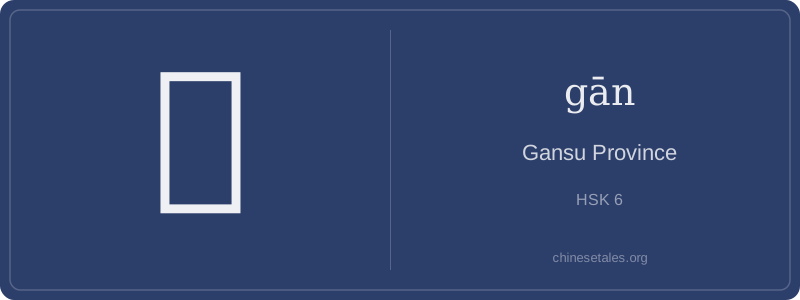
The earliest form of 甘 appears in oracle bone inscriptions as a simple, elegant pictograph: a mouth (口) with a horizontal stroke inside — not representing food, but the *sensation* of sweetness perceived within the mouth itself. This wasn’t a picture of sugar or fruit; it was a radical abstraction of subjective experience — one of the earliest Chinese characters to encode internal feeling rather than external objects. Over centuries, the mouth shape tightened into a compact square, and the internal stroke stabilized as a clean horizontal line, yielding today’s five-stroke 甘: two verticals framing a top horizontal, a middle horizontal, and a bottom horizontal — like three gentle layers of sweetness settling in the mouth.
This sensory origin explains why 甘 never meant ‘sugar’ or ‘honey’, but always ‘sweetness as felt’ — hence its natural extension to emotional states: delight, willingness, acceptance. In the *Analects*, Confucius praises disciples who ‘甘贫’ (gān pín, ‘find contentment in poverty’); here, 甘 conveys inner alignment, not gustatory pleasure. The character’s visual simplicity — just three horizontals between two verticals — mirrors its philosophical weight: profound meaning distilled into serene minimalism. By the Han Dynasty, 甘 was already used geographically for the western region now called Gansu, honoring the ancient Gan Prefecture — a linguistic fossil preserving a taste of antiquity in modern maps.
Imagine you’re sipping a cup of bittersweet tea in Lanzhou, capital of Gansu Province — and your host proudly points to the provincial name on a sign: 甘肃省 (Gānsù Shěng). That first character, 甘, isn’t just a geographical label — it’s a whisper from ancient taste buds. Originally meaning 'sweet' or 'delightful', 甘 evokes visceral pleasure: the warmth of honey on the tongue, the quiet satisfaction of a hard-won success. In modern usage, though, its core semantic role has narrowed almost exclusively to proper nouns — especially Gansu, where it serves as a historical shorthand inherited from the ancient Gan Prefecture (甘州) of the Tang Dynasty.
Grammatically, 甘 rarely stands alone as a verb or adjective outside fixed names or literary expressions. You won’t say *‘wǒ gān zhè gè kǔchá’* (I sweeten this bitter tea) — that would be nonsensical. Instead, it appears in classical-style compounds like 甘愿 (gān yuàn, ‘willingly accept’) or 甘心 (gān xīn, ‘to resign oneself’), where it retains its archaic flavor of ‘heartfelt acceptance’. Learners often mistakenly treat 甘 as a general synonym for ‘sweet’ (like 甜), leading to awkward phrasing — remember: 甜 describes literal taste; 甘 suggests moral or emotional sweetness, often with resignation or humility.
Culturally, 甘 carries quiet dignity. It’s never flashy — no red banners or loud slogans — yet it anchors one of China’s most historically layered provinces, a Silk Road crossroads where Buddhist sutras met Persian caravans. Its minimal five strokes belie deep resonance: in poetry, 甘 can evoke both sacrifice (甘于清贫, ‘content with poverty’) and grace (甘之如饴, ‘finding sweetness even in hardship’). Mispronouncing it as gǎn (third tone) is common — but that tone belongs to 感, not 甘. Stick to gān — level, calm, and deeply rooted.