甭
Character Story & Explanation
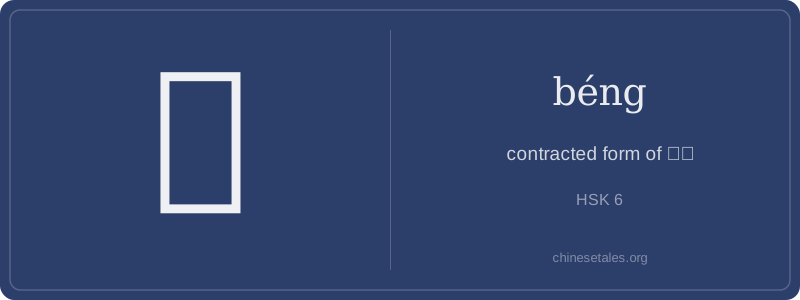
The character 甭 has no oracle bone or bronze inscription ancestry — it’s a Ming–Qing vernacular invention, likely first appearing in handwritten folk plays and Beijing opera scripts. Its form is brilliantly pragmatic: the top is a simplified, flattened 不 (bù), its two diagonal strokes bent inward like a frown, fused directly onto the square frame of 用 (yòng), whose inner ‘冂’ (jiōng) radical becomes the lower container. The nine strokes emerge not from pictorial logic, but from handwriting economy — scribes merged the characters so tightly that the ‘not’ visually suppresses the ‘use’, turning necessity into non-necessity at a glance.
This visual fusion mirrors its semantic birth: 甭 crystallized from rapid speech where 不用 slurred into a single syllable, then got fossilized into a written glyph. Unlike classical contractions like 之乎者也, 甭 never entered formal literary Chinese — it remained proudly colloquial, flourishing in Qing dynasty vernacular novels like Dream of the Red Chamber (in later editions and oral retellings) and exploding in 20th-century Beijing-based literature. Its shape *is* its meaning: a compact, almost defiant shorthand for refusing obligation — a tiny rebellion in ink.
Think of 甭 not as a standalone character, but as linguistic graffiti — a bold, colloquial contraction born from spoken Beijing dialect in the late Qing and early Republican eras. It’s not ancient; it’s *alive*, forged by speakers who’d rather say one smooth syllable than two clipped ones: 不用 (bù yòng) → béng. Visually, it’s a radical marriage: the top half is a stylized ‘bù’ (不) crammed over the bottom ‘yòng’ (用), like a hurried signature where the ‘not’ literally sits on top of ‘use’. This isn’t formal writing — you’ll rarely see it in official documents or newsprint, but it’s everywhere in dialogue, subtitles, and casual writing (think WeChat chats or sitcom scripts).
Grammatically, 甭 functions exactly like 不用 — a modal verb meaning ‘no need to’ or ‘don’t have to’, always followed by a verb: 甭担心 (béng dānxīn, ‘no need to worry’), 甭客气 (béng kèqì, ‘don’t bother being polite’). Crucially, it *cannot* stand alone as a noun or adjective — unlike 不要 or 别, it only negates necessity, never prohibition or desire. Learners often misplace it mid-sentence or try to use it with past-tense particles like 了 — a red flag: 甭 doesn’t take aspect markers. It’s stubbornly present/future-oriented.
Culturally, 甭 carries urban warmth and slight irreverence — it’s the linguistic equivalent of leaning back in your chair and waving a hand: ‘Relax, it’s fine.’ Overusing it in formal settings sounds dismissive; underusing it in Beijing banter sounds stiff. And yes — that alternate pronunciation bèng? It’s real, but *only* in rare dialectal compounds like 甭管 (bèng guǎn, ‘don’t bother’), where tone sandhi shifts the first syllable. For HSK 6, stick with béng — that’s the voice of modern spoken Mandarin.