畔
Character Story & Explanation
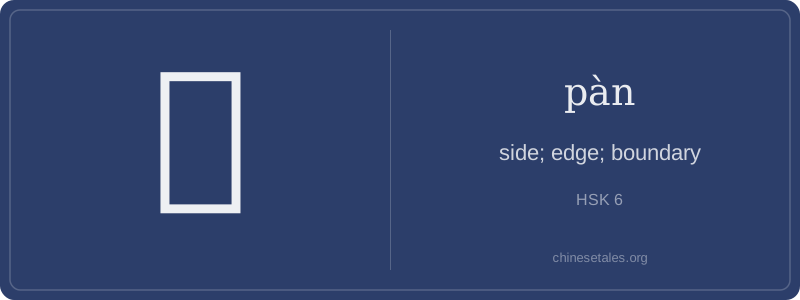
The earliest form of 畔 appears in bronze inscriptions as a field (田) with a vertical stroke or short line drawn beside it—like a marker post planted firmly at the outer limit of cultivated land. Over time, that marker evolved into the ‘half-tree’ component 半 (bàn), which wasn’t originally ‘half’ but a stylized depiction of a boundary stake or surveyor’s rod. By the seal script era, the two parts fused: 田 (field) + 半 (boundary marker) = ‘the defined edge of the field.’ Stroke by stroke, the modern 10-stroke form solidified—four strokes for 田, six for 半—retaining that ancient surveyor’s precision.
This visual logic shaped its meaning: from literal farmland margin → riverside bank (water meets land) → abstract moral or ideological boundary. In the *Analects*, Confucius says, ‘君子喻于义,小人喻于利’—and later commentators noted that straying from righteousness is like stepping beyond the 畔 of virtue. The Tang poet Wang Wei wrote ‘行到水窮處,坐看雲起時’—but he sat not just anywhere, but at the water’s 畔, where limits dissolve into contemplation. Even today, when a Chinese writer describes someone ‘站在时代的畔上’, they’re not just ‘on the side of the era’—they’re poised at its decisive, trembling threshold.
At its heart, 畔 (pàn) is all about liminality—the quiet, charged space where one thing stops and another begins: the edge of a field, the bank of a river, the boundary between loyalty and rebellion. Visually anchored by the 田 (tián, 'field') radical, it evokes agrarian China, where land boundaries were life-and-death matters—measured not with GPS, but with bamboo stakes and ancestral memory. This isn’t just ‘side’ like a casual direction; it’s *definitive* edge—often poetic, sometimes political.
Grammatically, 畔 rarely stands alone in modern speech. You’ll find it mostly in literary or set phrases: as a noun (e.g., 河畔, ‘riverside’), or in classical-style verbs like 畔道 (to abandon moral principle—literally ‘abandon the Dao’s edge’). Learners often mistakenly use it like 边 (biān, ‘side’) in everyday contexts—‘the side of the table’ is 桌子边, never 桌子畔. That’s a red flag for over-literary register. Also, note that while 畔 can mean ‘boundary,’ it’s never used for administrative borders—that’s 界 (jiè) or 疆 (jiāng).
Culturally, 畔 carries quiet weight: Confucius lamented ‘君子怀德,小人怀土’—yet even he walked beside rivers, reflecting on virtue at the water’s edge. The character appears in the famous line ‘不逾矩’ (not overstepping the boundary), echoing 畔’s deeper sense of ethical contour. Mispronouncing it as bàn (a common slip) risks confusion with 半 (‘half’)—a tiny tone shift that swaps geography for arithmetic!