疙
Character Story & Explanation
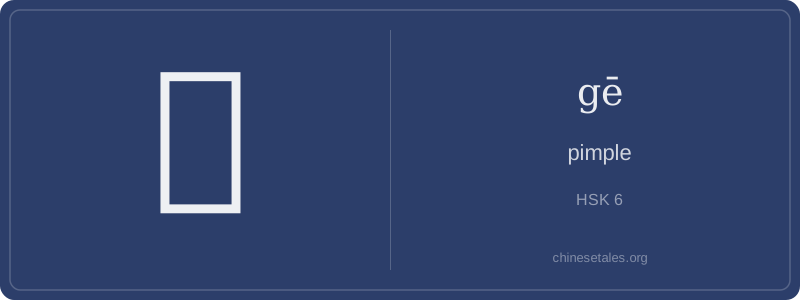
The earliest trace of 疙 appears not in oracle bones, but in late medieval vernacular texts — it’s a relatively young character, born from phonetic-semantic compounding. Its left side 疒 (nè) is the 'sickness' radical — originally a pictograph of a person lying sick in bed, evolving into today’s simplified roof-and-bed shape. The right side 告 (gào) was borrowed purely for sound (gē is a dialectal variant of gào), but visually, the 'mouth' (口) atop 'cow' (牛) in 告 subtly echoes the idea of something *rising up* — like a bump emerging from skin. Stroke by stroke: start with the sickness radical (5 strokes), then add 告 (7 strokes total, but shared stroke count makes 疙 8 — note the dot in 告 becomes the final stroke, merging cleanly).
By the Ming dynasty, 疙 had settled into its role in northern dialects, appearing in vernacular novels like Water Margin in phrases like '肉疙瘩' (ròu gēda, 'meaty lump'). Its meaning never strayed far from physical protuberance — but quickly bloomed metaphorically: a 'knot' in relationships, a 'lump' in speech, even 'clumsiness' in movement. The character’s very construction — illness radical + sound component that means 'to announce' — hints at how bodily anomalies 'announce themselves' without permission. It’s a quiet rebellion in script form.
At its core, 疙 (gē) is a tactile, slightly unglamorous word — it’s the little bump you feel under your finger, not the clinical term doctors use. It belongs to the 疒 (nè) radical family — characters related to illness or bodily conditions — and carries a folksy, colloquial warmth (or discomfort!). Unlike formal medical terms like 痤疮 (cuóchuāng, 'acne'), 疙 appears almost exclusively in compound words like 疙瘩 (gēda), where it softens the clinical edge with earthy familiarity. You’ll rarely see it solo in writing — it’s a team player, always paired.
Grammatically, 疙 never stands alone: it only appears in fixed compounds (e.g., 疙瘩, 疙里疙瘩). Learners sometimes mistakenly try to use it as a verb ('to pimple') or noun on its own — but no! It’s morphologically bound, like the '-gle' in English 'twinkle' or 'mingle'. Even in spoken Mandarin, saying just 'gē' sounds incomplete, like muttering 'pim-' without finishing 'ple'. Its tone (first tone) is steady and solid — mirroring the physical stubbornness of a raised bump.
Culturally, 疙 is a linguistic comfort food: it’s used affectionately ('小疙瘩' for a tiny, harmless flaw), metaphorically ('心里有疙瘩' — 'a knot in the heart', meaning unresolved resentment), and even humorously ('疙里疙瘩' describing something lumpy, awkward, or unnecessarily complicated). A classic learner pitfall? Confusing 疙 with 易 (yì) or 舌 (shé) due to visual similarity in handwriting — but those have nothing to do with skin or bumps. Remember: if it involves texture, tension, or tenderness — think 疙.