症
Character Story & Explanation
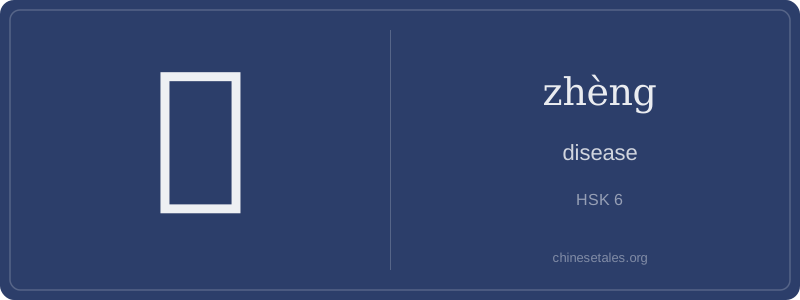
The character 症 first appeared in seal script around 220 BCE, built from the radical 疒 (nè, 'sickness') on the left — originally a pictograph of a person lying ill under a roof — and 右 (yòu, 'right') on the right. But this ‘right’ wasn’t about direction: in ancient phonetic loan usage, 右 served purely as a sound hint (its Old Chinese pronunciation *ŋʷrəʔ* approximated the word for ‘manifestation’). Over centuries, 右 simplified into the modern 正 (zhèng) shape — not the ‘correct’ character 正, but a graphical twin born of clerical script streamlining. Ten strokes emerged: two for the ‘sick person’ roof, three for the bed-like base of 疒, then five for the stylized 正.
This visual evolution mirrors its semantic journey: from early texts like the *Huangdi Neijing* (c. 300 BCE), where 症 described visible bodily disruptions (‘the skin reddens, the pulse surges’), to Tang dynasty medical manuals formalizing 症 as the outward ‘face’ of internal imbalance. Crucially, it diverged from 病 (bìng), which meant the underlying pathogenic force — like wind-cold invading the lungs. 症 was the lung’s coughing reply. That duality persists today: 病 is the diagnosis; 症 is what the patient describes in their own words — making 症 the character where medicine meets human voice.
Think of 症 (zhèng) as Chinese medicine’s version of a 'symptom dossier' — not just the disease itself, but the full clinical profile: fever + cough + fatigue + lab results. Unlike English ‘disease’, which often implies a named condition (e.g., diabetes), 症 emphasizes *observable manifestations* — the body’s telltale language. That’s why you’ll hear doctors say 感冒症状 (gǎnmào zhèngzhuàng, 'cold symptoms'), not 感冒疾病. It’s rarely used alone; it almost always appears in compounds like 症状 or 并发症.
Grammatically, 症 is never a verb and never stands unmodified — you won’t say *‘he has 症’*. Instead, it pairs with classifiers or modifiers: 早期症状 (zǎoqī zhèngzhuàng, 'early-stage symptoms'), 临床症状 (línchuáng zhèngzhuàng, 'clinical symptoms'). A classic learner trap? Using 症 where 病 (bìng, 'illness') fits better — e.g., saying *‘他得了症’* instead of *‘他得了病’* ('He got sick'). That sounds like he contracted a medical report.
Culturally, 症 reflects Traditional Chinese Medicine’s holistic lens: a ‘syndrome’ (证/zhèng, homophone!) isn’t just physical signs — it includes emotional state, tongue coating, pulse quality. Modern usage keeps that layered feel: 新冠后遗症 (xīnguān hòuyízhèng, 'long COVID syndrome') treats lingering effects as an integrated pattern, not isolated symptoms. And yes — that rare alternate reading zhēng? It appears only in ancient compound 症结 (zhēngjié, 'crux/real root cause'), where it echoes the archaic sense of ‘knotted obstruction’ — like a blocked river of qi.