瘸
Character Story & Explanation
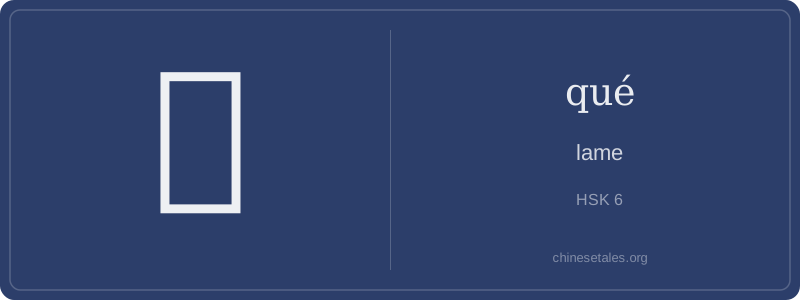
The earliest form of 瘸 appears in late Warring States bamboo texts, not oracle bones — it’s a relatively young character. Its left side, 疒, was already standardized as the 'sickness' radical (a person lying on a mat). The right side, 虺 (huǐ), originally depicted a coiling venomous snake — but here it’s borrowed phonetically (both 虺 and 瘸 were pronounced *kʰuəj* in Middle Chinese). Over centuries, 虺 simplified: its 'insect' top (虫) merged with the curved body, and the lower strokes condensed into the modern 可-like shape. By the Tang dynasty, the full 16-stroke form stabilized — every stroke now feels deliberate, almost heavy, like a weighted gait.
This phonetic borrowing is key: 瘸 isn’t pictographic — it doesn’t show a bent leg. Instead, it’s a brilliant sound-meaning marriage: 疒 gives the domain (bodily impairment), and 虺 provides the pronunciation anchor. In classical texts, 瘸 rarely appears alone; it’s embedded in compound terms like 瘸足 (lame foot) in medical manuals from the Song dynasty. The character’s visual weight — those thick, downward-slanting strokes in the right component — unconsciously echoes imbalance, making the written form itself limping. Even today, calligraphers note how the final stroke drags slightly, refusing symmetry — a silent nod to its meaning.
瘸 (qué) is the go-to word for 'lame' in modern Mandarin — but it’s not clinical or detached like English 'lame'; it’s visceral, often colloquial, and carries a hint of pity, resilience, or even wry humor. Think of someone limping down an alley after a sprained ankle, or an old bicycle with one bent spoke — 瘸 nails that imperfect, asymmetrical, stubbornly functional state. It’s almost always used as an adjective before a noun (瘸腿、瘸子) or in predicate position (他腿瘸了), never as a verb — you don’t 'to lame' something; you *are* 瘸 or *have* a 瘸 condition.
Grammatically, it’s rigid: no comparative forms (no *more lame*), no adverbial use (*very lame* → 很瘸 is acceptable but rare; better: 腿脚不太灵便). Learners often mistakenly use it metaphorically like English 'lame' ('That joke is lame!'), but that sense is covered by 没劲儿, 逊, or 土 — 瘸 stays stubbornly physical. Also beware: while 瘸子 is widely understood, it’s increasingly considered blunt or mildly offensive in formal contexts — think 'cripple' in English — so use it only when tone matches (e.g., self-reference among friends or in literary narration).
Culturally, 瘸 appears in folk idioms like 瘸驴拉磨——瞎转圈 (a lame donkey grinding grain — going in blind circles), highlighting futility with empathy, not mockery. Historically, it’s tied to bodily integrity ideals in Confucian thought — disability wasn’t pathologized, but integrated into moral metaphors about perseverance. Modern usage leans pragmatic: a 瘸马 might be passed over at auction, but a 瘸匠 (a skilled artisan with a limp) commands respect. The radical 疒 signals illness, but here it’s less 'disease' and more 'structural deviation from the norm' — a subtle, powerful distinction.