皆
Character Story & Explanation
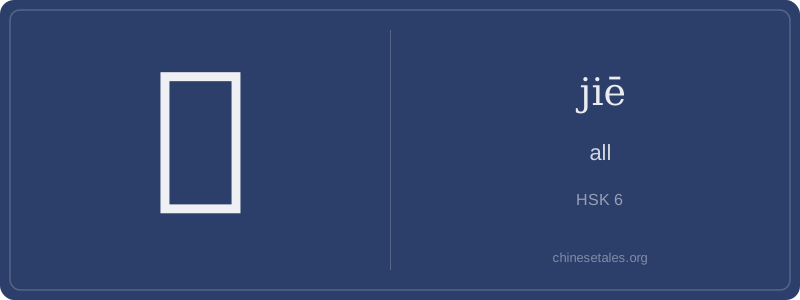
The earliest form of 皆 appears in bronze inscriptions around 1000 BCE: a combination of 白 (bái, 'white' — originally a pictograph of a rice grain or open mouth, later associated with clarity/purity) atop 比 (bǐ, 'to compare' or 'side-by-side', showing two people facing each other). Over centuries, 比 simplified into the bottom component we see today — two parallel strokes with a connecting hook — while 白 retained its clean, boxy shape. The nine-stroke modern form crystallized in the Han dynasty clerical script: 白 (5 strokes) firmly anchored above the streamlined 比-derived base (4 strokes), visually echoing 'clarity + alignment = universal agreement'.
This visual logic became semantic truth: if people stand side-by-side (比) in clear understanding (白), then consensus is total — hence 皆 meaning 'all, without exception'. By the Warring States period, it was already entrenched in philosophical discourse: the Zuo Zhuan uses 皆 37 times to express collective fate or unanimous judgment. Its elegance lies in how its structure enacts its meaning — no stroke is decorative; every line participates in the idea of unified, visible accord. Even today, when writers choose 皆 over alternatives, they subtly invoke that ancient image of aligned, lucid humanity.
Think of 皆 (jiē) as the Chinese equivalent of the Latin 'omnes' — not just 'all', but a sweeping, inclusive, almost ceremonial 'all', carrying the weight of classical authority. Unlike the more neutral 全 (quán) or colloquial 都 (dōu), 皆 feels elevated, literary, and slightly formal — like quoting Shakespeare instead of texting 'everyone’s here'. It’s rarely used alone; it clings to verbs or adjectives like a quiet chorus: 'All agree', 'All perish', 'All are equal' — always implying universality without exception.
Grammatically, 皆 is an adverb that precedes the predicate, never the subject. You’ll see it in patterns like 皆 + verb (皆知 — 'all know'), 皆 + adjective (皆美 — 'all beautiful'), or after a subject + 皆 (天下人皆爱之 — 'All people under heaven love it'). Learners often mistakenly place it before nouns ('*皆 students') — but 皆 doesn’t modify nouns directly; for that, use 全部 or 所有. Also, avoid overusing it in speech: while common in essays, news headlines, and idioms, native speakers rarely say '我皆知道' — they’d say '我全都知道' or simply '我都知道'.
Culturally, 皆 echoes Confucian and Daoist ideals of universal harmony — think of Mencius declaring '民皆可為堯舜' ('All people can become Yao or Shun'). Its frequent appearance in classical texts and modern formal writing (e.g., legal documents or political slogans) gives it a tone of irrefutable consensus. A classic trap? Confusing it with the homophone 接 (jiē, 'to receive') — same sound, utterly different world. When you hear jiē in context, ask: Is this about inclusion — or about contact?