盛
Character Story & Explanation
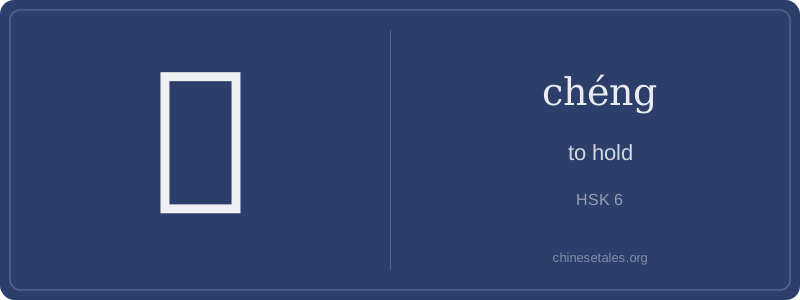
The earliest form of 盛 appears on Western Zhou bronze inscriptions as a vivid pictograph: a wide-mouthed vessel (like a ceremonial wine jar) with grains or liquid spilling slightly over the rim — unmistakably depicting 'fullness'. Over centuries, the vessel shape simplified into the 皿 radical at the bottom, while the top evolved from a stylized representation of overflowing grain into 成, which by the Qin seal script had stabilized as both semantic reinforcement (‘completion’) and phonetic guide. By the Han clerical script, all 11 strokes were fixed: the horizontal stroke at the top, the three verticals and hooks of 成, then the clean square base of 皿 — no flourish, just functional fullness.
This visual logic shaped its literary life: in the Shijing (Book of Odes), 盛 appears in sacrificial contexts — 'The bronze ding holds the millet offering' — linking containment to ritual propriety. Later, in Tang poetry, it gained poetic weight: Wang Wei wrote '竹喧归浣女,莲动下渔舟。随意春芳歇,王孙自可留。' where 盛 subtly echoes in related terms for vessels carrying spring’s bounty. Even today, its shape whispers 'vessel filled to the brim' — no abstraction, just ancient pottery meeting modern grammar.
Think of 盛 (chéng) as the humble 'container verb' — not flashy like 拿 (ná, 'to take') or 抓 (zhuā, 'to grab'), but quietly essential: it means 'to hold' in the physical, vessel-like sense — think bowls, jars, or cups holding liquid or grain. Its radical 皿 (mǐn) is the 'dish/utensil' radical, appearing in characters like 盘 (pán, 'plate') and 盒 (hé, 'box'), instantly anchoring the meaning in containment. The top part 成 (chéng) isn’t just phonetic; it subtly reinforces completion — something fully held, filled to capacity. That’s why 盛 always implies *capacity being met*: you don’t just 'hold' water with 盛 — you *fill a vessel with* it.
Grammatically, 盛 is almost exclusively used in the verb-object construction, often with measure words like 一勺 (yī sháo, 'a spoonful') or 一碗 (yī wǎn, 'a bowl'). It’s rarely standalone — you’ll say 水盛满了 (shuǐ chéng mǎn le, 'the water has filled up'), not *我盛*. And crucially: it’s transitive — you must specify *what* is being held *in what*. Learners often mistakenly use it like English 'hold' ('I hold the cup'), but in Chinese, that’s 端 (duān) or 拿 — 盛 only applies when the container is actively *receiving and containing*.
Culturally, this character embodies a quiet precision: Chinese doesn’t blur the line between 'holding an object' and 'holding contents in a vessel' — they’re entirely different verbs. A common error is confusing chéng with shèng (as in 盛大, shèngdà, 'grand'), leading to absurd sentences like *今天很盛* ('Today is very grand!' instead of *今天很热*, 'Today is very hot!'). Remember: chéng = container + content; shèng = flourishing, abundance — same character, two worlds.