监
Character Story & Explanation
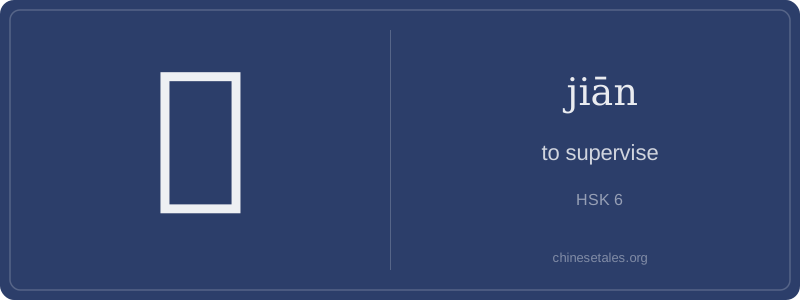
The earliest form of 监, found on Shang dynasty oracle bones, was a vivid pictograph: an eye (⺈, later evolving into the top component 丵) peering down into a large open container — the radical 皿 (mǐn), meaning 'vessel' or 'dish'. Imagine an official crouching beside a granary vat, squinting to check grain levels or detect theft. Over centuries, the eye simplified into 丶 + 一 + 丨, then fused with the vessel below; by the seal script era, the structure stabilized into today’s 10-stroke form — still unmistakably 'eye over container'.
This visual logic directly shaped its meaning: to watch *over something tangible and valuable*. In the *Book of Documents*, 监 appears in phrases like '监于先王' ('take the former kings as a mirror') — extending the idea from physical inspection to moral reflection. By the Han dynasty, 监 had become a formal title for inspectors-general (e.g., 御史监, Yùshǐ Jiān), cementing its association with institutional scrutiny. Even today, the 皿 radical silently reminds us: supervision isn’t abstract — it’s about guarding what’s held in trust.
Think of 监 (jiān) as China’s ancient ‘security camera’ — not electronic, but human: a vigilant official watching over grain stores, tax records, or imperial workshops. Its core feeling isn’t passive observation but active, authoritative oversight — closer to a modern auditor or compliance officer than a casual observer. That’s why it appears in words like 监督 (jiān dū, 'to supervise') and 监察 (jiān chá, 'to inspect'), always implying institutional authority and accountability.
Grammatically, 监 rarely stands alone in speech — it’s almost always the first syllable in disyllabic verbs or nouns. Learners often mistakenly use it like English ‘watch’ (e.g., *我监他*), but that’s ungrammatical; instead, you say 他受到监督 (tā shòu dào jiān dū, 'He is under supervision'). It also forms key bureaucratic nouns: 监狱 (jiān yù, 'prison') literally means 'supervision enclosure' — a chilling reminder that confinement and oversight were historically inseparable concepts.
Culturally, 监 carries weighty connotations of state power and moral scrutiny. In classical texts like the *Zuo Zhuan*, 监 was used for officials appointed to ‘watch over virtue’ — blending ethics and administration. A common mistake? Confusing it with 看 (kàn, 'to look') — but while 看 is neutral and sensory, 监 is normative and hierarchical. Also, don’t forget the alternate reading jiàn (as in 太监 — tài jiàn, 'eunuch'): here, 监 originally referred to a palace supervisory bureau, later narrowing to its infamous role — a stark semantic shift from public service to intimate court control.