眨
Character Story & Explanation
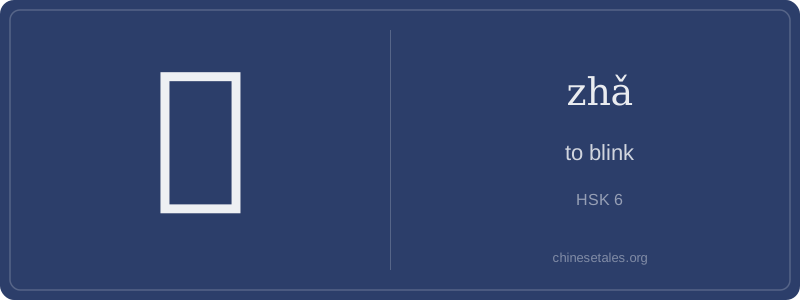
The earliest forms of 眨 appear in Han dynasty clerical script, evolving from a combination of 目 (mù, ‘eye’) on the left — unmistakably pictographic, showing an eye with pupil — and 乏 (fá, ‘to lack, be exhausted’) on the right. Wait — ‘exhaustion’? Not quite! That right-hand component was actually a phonetic loan: 乏 here serves *only* to hint at pronunciation (early Middle Chinese *tʃrɛp*), while the left 目 anchors meaning. Over centuries, 乏 simplified visually into the modern 乏-like shape (but note: it’s not the character 乏 itself — it’s a cursive derivative), losing its semantic load entirely and becoming pure phonetic scaffolding.
This evolution reflects a classic Chinese orthographic shift: from meaning-plus-sound clarity to streamlined efficiency. By the Tang dynasty, 眨 was fully standardized as a left-right compound — 目 + 乏 — where the eye radical telegraphs the domain (vision, physiology), and the right side whispers the sound. Interestingly, classical poets rarely used 眨 alone; instead, they favored the compound 眨眼, as in Li Bai’s line ‘眨眼不见君’ (zhǎ yǎn bù jiàn jūn — ‘You vanished before my eyes could blink’), cementing the phrase as the idiomatic unit for sudden disappearance or fleeting time.
At its heart, 眨 (zhǎ) isn’t just ‘to blink’ — it’s the *instantaneous, involuntary flicker* of attention: a micro-pause in perception that signals alertness, surprise, or even deception. Unlike English ‘blink’, which can be neutral or habitual, 眨 in Chinese often carries subtle psychological weight — think of someone blinking rapidly when caught off guard, or not blinking at all during intense focus. It’s a verb of bodily immediacy, always describing a single, discrete action (not a continuous state), so you’ll never say *‘he is blinking’* with progressive aspect — instead, you’d use repetition like 眨了眨 (zhǎ le zhǎ) for ‘blinked twice’.
Grammatically, 眨 shines in vivid descriptive writing and spoken nuance. It pairs beautifully with aspect particles: 眨眼间 (zhǎ yǎn jiān) — literally ‘in the time it takes to blink an eye’ — means ‘in an instant’, and appears constantly in novels and speeches. Learners often wrongly try to use 眨 as a noun (e.g., *a blink*) — but in Chinese, the noun form is almost always 眨眼 (zhǎ yǎn), never just 眨 alone. Also, avoid overusing it with objects: you don’t ‘blink your eyes’ (that’s redundant — 目 is already in the radical!); you simply 眨.
Culturally, this tiny gesture carries surprising gravity. In classical texts, unblinking gaze (不眨) signals unwavering resolve (like Guan Yu reading the Spring and Autumn Annals while having his arm operated on), while rapid blinking (直眨) hints at nervousness or dishonesty. A common mistake? Confusing 眨 with 瞥 (piē, ‘to glance’) — one is inward, reflexive, and eyelid-driven; the other is outward, intentional, and eye-movement-driven.