眶
Character Story & Explanation
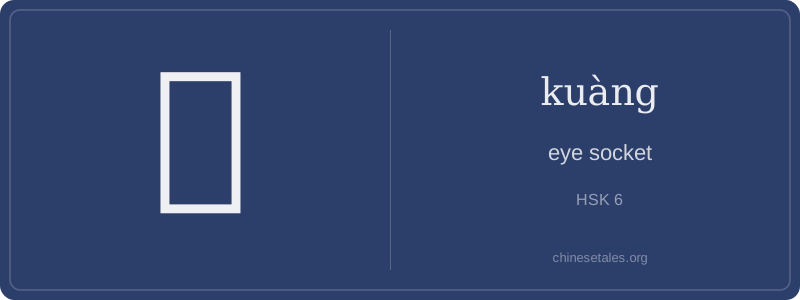
The earliest form of 眶 appears in seal script as a combination of 目 (mù, 'eye', the radical) on the left and 匡 (kuāng, 'frame, basket', later simplified to 匚 + 王) on the right. The original pictograph wasn’t a literal skull — rather, it depicted an eye enclosed within a rectangular boundary, evoking enclosure, support, and structural containment. Over time, the right-hand side evolved from the full 匡 (a basket shape symbolizing enclosure) into the modern 匡-like component — retaining the idea of a rigid, defining border around the visual organ.
This visual logic shaped its meaning: from 'enclosing frame for the eye' to 'bony orbit'. By the Han dynasty, 眶 was standard in medical texts like the *Huangdi Neijing*, describing the eye’s physical housing. Its presence in Tang poetry — like Du Fu’s line '泪随声堕眶' ('tears fell with each cry, dropping from the sockets') — reveals how deeply the character’s spatial specificity resonated: tears didn’t just fall *from the eyes*, but *over the edge of their bony rim*, making emotion feel anatomically grounded and viscerally real.
Think of 眶 (kuàng) as the 'eye’s architectural frame' — not the eye itself, but the bony cavity that cradles it, like a custom-made marble socket holding a priceless jade orb. In English, we say 'eye socket' clinically; in Chinese, 眶 carries quiet anatomical precision and subtle poetic weight: it appears in literary descriptions of tears welling *in* the 眶 (not just 'in the eyes'), emphasizing containment, tension, and imminent overflow — as if the socket itself is holding its breath.
Grammatically, 眶 is almost always bound: you won’t say *'I rubbed my kuàng'* alone. It lives inside compounds (e.g., 眼眶, 泪眶) or descriptive phrases like '泪盈眼眶' (tears brimming *in the eye sockets*). Learners often wrongly substitute 目 (mù, 'eye') or 眼 (yǎn, 'eye') — but 眶 is never generic; it’s specifically the bony rim and hollow. You can’t ‘open’ or ‘close’ a 眶 — only fill, swell, or deepen it.
Culturally, 眶 is a silent witness to emotion: classical poetry uses it to imply restraint — tears held *at the brink*, not yet spilled. A common mistake? Using 眶 where 眼 would suffice in casual speech ('my eyes hurt' → 眼疼, not *眶疼*). Also, don’t confuse it with 胯 (kuà, 'hip joint') — same pinyin, wildly different anatomy!