睦
Character Story & Explanation
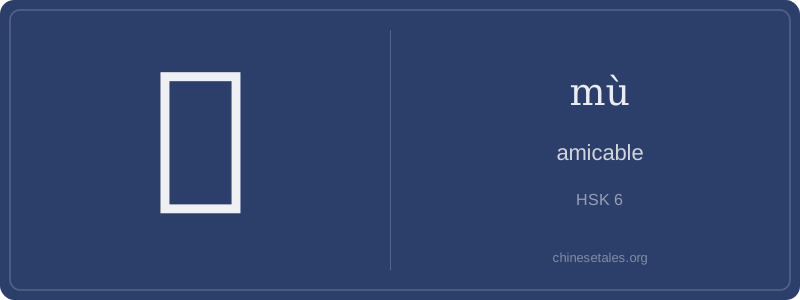
The earliest form of 睦 appears in bronze inscriptions around 1000 BCE: a simplified eye (目) combined with a phonetic component that looked like 莫 (mò, later evolving into 募/慕). Over centuries, the top part condensed from 莫’s complex ‘sun at dusk’ (日 + 艸 + 日) into the modern ‘亠 + 日 + 大’ shape — but crucially, the 目 radical stayed front and center. Visually, it’s a striking fusion: the eye looking outward, anchored by a structure suggesting ‘gathering’ or ‘intention’. By the Han dynasty, the character stabilized into its current 13-stroke form — elegant, balanced, and quietly watchful.
This visual logic shaped its meaning: if 目 means ‘to see’, and the upper part hints at gathering or mutual presence, then 睦 literally evokes ‘eyes meeting in shared goodwill’. In the Classic of Filial Piety, it describes how brothers should ‘look upon one another with mutual respect’ — not just coexist, but *see* each other with benevolent clarity. Even today, when Chinese say ‘和睦’, they’re invoking that ancient idea: harmony isn’t passive; it’s the result of intentional, clear-eyed regard for others.
At its heart, 睦 (mù) isn’t just ‘amicable’ — it’s the quiet hum of harmony between people who *choose* to see each other clearly and kindly. Think less ‘friendly chat’ and more ‘mutual respect that settles into the bones’, like neighbors sharing tools without being asked, or colleagues resolving tension before it becomes friction. It’s a deeply Confucian word: not about loud affection, but about relational stability rooted in sincerity and shared understanding.
Grammatically, 睦 is almost always found in compounds — you’ll rarely see it alone. It functions as an adjective or noun, often paired with words like 邻 (lín, neighbor), 族 (zú, clan), or 里 (lǐ, community). Crucially, it’s never used predicatively like ‘He is mù’ — instead, say ‘邻里和睦’ (lín lǐ hé mù: ‘neighbors live in harmony’). Learners sometimes wrongly try to use it as a verb or attach it directly to pronouns; remember: 睦 is a *state*, not an action — it’s the calm after the relational work is done.
Culturally, 睦 carries subtle weight: it implies reciprocity and effort. In classical texts like the Book of Rites, 睦 appears in descriptions of ideal kinship — not just blood ties, but the deliberate cultivation of warmth across generations. A common mistake? Confusing it with 慕 (mù, ‘to admire’) or 木 (mù, ‘wood’). The key is the 目 (eye) radical: this character is about *seeing* others well — truly, fairly, kindly — which is where harmony begins.