瞻
Character Story & Explanation
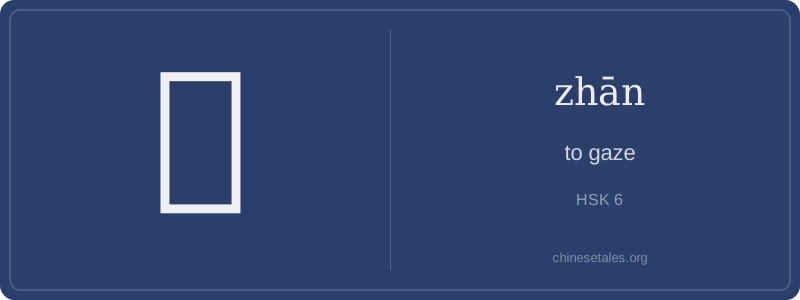
The earliest form of 瞻 appears in bronze inscriptions as a combination of 目 (eye) and 攀 (to climb, later simplified to an upper component resembling + 彡). The original pictograph wasn’t just an eye — it showed eyes looking *upward along a slope or ladder*, with decorative strokes (彡) suggesting focused intensity or even wind-blown hair from straining upward. Over centuries, the climbing element evolved into the top half — the ‘zhān’-sounding phonetic component — while 目 remained firmly rooted at the bottom, anchoring the meaning in vision.
This upward-looking image became deeply symbolic in Confucian and Daoist texts: in the *Book of Songs*, ‘瞻彼淇奥’ (gaze upon that bend of the Qi River) isn’t mere scenery — it’s contemplative reverence for moral refinement embodied in landscape. By the Tang dynasty, 瞻 was cemented as the verb of choice for gazing upon sages, ancestors, or sacred sites — always implying humility, distance, and aspirational alignment. Its shape still whispers: ‘eyes reaching upward, not out’.
At its core, 瞻 isn’t just ‘to gaze’ — it’s to gaze *upward*, *reverently*, or *with solemn attention*. Think less ‘glance at your phone’ and more ‘gaze upon a mountain peak at dawn’ or ‘look up to a revered elder’. It carries weight, intention, and often hierarchy: you 瞻 a monument, a leader, or ancestral tablets — never your lunch. This isn’t casual seeing; it’s visual respect made grammatical.
Grammatically, 瞻 is almost always transitive and formal — you’ll rarely find it alone in speech. It appears in compound verbs (瞻仰, 瞻望), classical-style clauses (‘瞻彼淇奥’), or literary narration. Learners mistakenly use it like 看 or 观, but 瞻 resists colloquialism: saying ‘我瞻了他一眼’ sounds absurdly archaic, like saying ‘I didst behold him’. Instead, it thrives in fixed phrases — especially with 仰 (‘to look up in reverence’) — where the double ‘upward gaze’ intensifies solemnity.
Culturally, 瞻 reveals how Chinese aesthetics and ethics intertwine sight with virtue: to truly ‘see’ something worthy is to align your posture, mind, and moral stance. That’s why it’s ubiquitous in political rhetoric (瞻仰先烈), temple inscriptions, and poetry — not as description, but as ritualized acknowledgment. A common mistake? Overusing it in writing hoping to sound ‘elegant’ — but native readers instantly spot that as forced, like wearing hanfu to a coffee shop.