磁
Character Story & Explanation
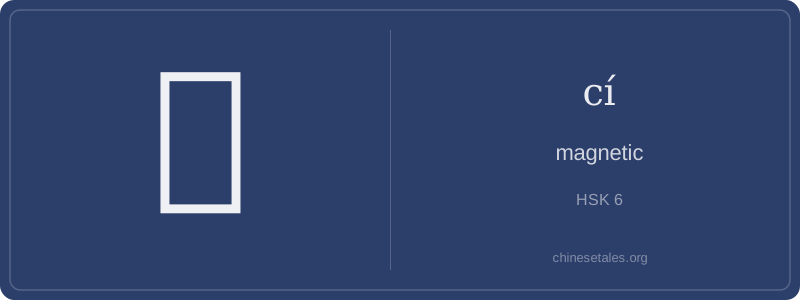
The earliest form of 磁 appears in Han dynasty seal script, not oracle bones — because magnetism wasn’t widely documented until iron metallurgy matured. Visually, it’s a masterclass in semantic + phonetic construction: left side 石 (shí, 'stone') — the meaning anchor — and right side 慈 (cí, 'kindness, compassion') — the sound clue. The modern 14-stroke shape preserves this balance: the stone radical’s three horizontal strokes at the top mimic layered rock strata, while the 慈 component (itself built from 心 'heart' under 兹 'now') flows downward with graceful, connected strokes — echoing how magnetic fields extend invisibly outward.
This character was born from observation, not abstraction. In the 1st-century BC text *Huainanzi*, lodestone (císhí) is described as 'drawing iron as a mother draws her child' — hence the phonetic choice 慈, evoking gentle, irresistible attraction. By the Song dynasty, Shen Kuo’s *Dream Pool Essays* detailed magnetic compasses using 磁针 ('magnetic needle'), cementing 磁 as the definitive term for this natural phenomenon — forever linking mineral substance, directional power, and quiet, unwavering pull.
At its core, 磁 (cí) isn’t just a scientific label — it’s a sensory word that evokes invisible force, quiet attraction, and subtle pull. Its radical 石 (shí, 'stone') anchors it in the physical world: ancient Chinese discovered magnetism not in labs but in lodestone — a naturally magnetic iron ore, literally 'magnetic stone'. That’s why 磁 always implies *material reality* behind the force: you wouldn’t say 磁的感情 ('magnetic feelings') metaphorically like English — that’s reserved for 魅力 (mèilì, 'charm').
Grammatically, 磁 is almost never used alone. It’s a classic modifier — always paired: 磁铁 (cítiě, 'magnet'), 磁场 (cíchǎng, 'magnetic field'), 磁性 (cíxìng, 'magnetism'). As an adjective, it must precede the noun and can’t take degree adverbs like 很 (hěn); you’d say 磁性强 (cíxìng qiáng, 'strong magnetism'), not *很磁. Learners often wrongly insert it into metaphors — 'a magnetic speaker' becomes 魅力十足的演讲者, not *磁的演讲者.
Culturally, 磁 carries quiet authority: it appears in high-stakes contexts — MRI machines (核磁共振, hémǐ gòngzhèn), maglev trains (磁悬浮列车), even quantum research. Mispronouncing it as cǐ (third tone) or chī (first tone) is common, but cí (second tone) is non-negotiable — it rhymes with 'see', not 'cheese'. And remember: it’s not about 'magic' — it’s about *measurable, mineral-based force*.