磋
Character Story & Explanation
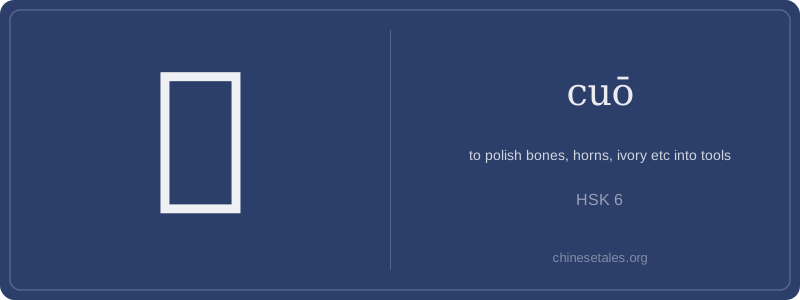
The earliest form of 磋 appears in bronze inscriptions as a composite: the left side showed a hand holding a tool (later simplified to the ‘stone’ radical 石), while the right depicted a horn or bone being worked — sometimes with parallel lines suggesting filing or grinding strokes. Over centuries, the ‘hand + tool’ merged into the modern 石 radical (stone), reflecting the abrasive stones used for polishing, while the right side evolved from a pictograph of horn (角) into the phonetic component 差 (chā/cuō), preserving the sound but losing the horn shape — a classic case of phonetic loan and semantic drift.
This visual logic stayed true even as meaning expanded: by the Warring States period, 磋 appeared in the *Book of Songs* (Shījīng) in the famous line ‘如切如磋,如琢如磨’ — comparing moral self-cultivation to cutting, polishing, carving, and grinding precious materials. Here, 磋 wasn’t literal horn-polishing anymore, but a metaphor for refining virtue through earnest dialogue — cementing its shift from craft technique to intellectual and ethical refinement. The stone radical thus became symbolic of rigor, not just material.
Think of 磋 (cuō) as the ancient Chinese equivalent of a master craftsman meticulously sanding a rough piece of jade — but originally, it was about polishing *bones*, *horns*, and *ivory* into ritual objects or tools. That tactile, iterative, refining energy is still central: it’s not just ‘to discuss’ in a casual sense — it’s to *hone ideas through careful, mutual exchange*, like sharpening a blade on a whetstone. The feeling is deliberate, respectful, and collaborative — never rushed or one-sided.
Grammatically, 磋 almost always appears in the compound 磋商 (cuōshāng), a formal verb meaning ‘to negotiate’ or ‘to consult formally’. You’ll see it in diplomatic statements, business contracts, or academic collaborations — never in texting your friend about dinner plans! It’s rarely used alone; saying *‘we cuō’* without context sounds archaic or poetic. Also, it’s transitive: you 磋商 *with someone* about *something*, so watch your prepositions — no ‘cuōshāng *at* the meeting’, but ‘cuōshāng *on* the terms’ or ‘cuōshāng *with* the delegation’.
Culturally, this character carries Confucian weight: it implies humility, patience, and shared responsibility in reaching understanding. Learners often mistakenly use it where 协商 (xiéshāng) or 讨论 (tǎolùn) would be more natural — confusing formality with frequency. Remember: 磋商 isn’t ‘chatting’ — it’s the verbal equivalent of polishing antler into a ceremonial scepter: slow, skilled, and socially significant.