祖
Character Story & Explanation
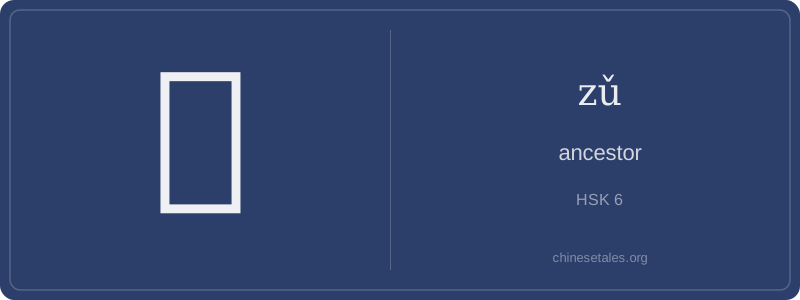
The earliest form of 祖 appears in Shang dynasty oracle bone inscriptions as a combination of two elements: the altar radical 礻 (originally 示, ‘altar’ or ‘divine sign’) and 且 (qiě), which looked like a stylized ancestral tablet — a tall, upright stone slab with horizontal lines representing offerings or inscribed names. In bronze script, 且 became more angular, its three horizontal strokes symbolizing layers of lineage, while 礻 evolved from a pictograph of an altar with smoke rising. By the seal script era, the two fused into a single coherent character: the left side 礻 retained its ritual connotation, and the right 且 solidified into its modern shape — nine strokes total, with the final dot (丶) added later to distinguish it from similar forms.
This visual fusion tells the story: 祖 isn’t just ‘a person who lived before you’ — it’s ‘the ancestor enshrined on the altar’, someone ritually summoned and honored. Classical texts like the *Book of Rites* (Liji) treat 祖 as the foundational figure in sacrificial hierarchy: ‘立祖以尊尊’ (lì zǔ yǐ zūn zūn) — ‘Establish the ancestor to honor the honored’. Even today, the stroke order reflects reverence — writing 礻 first (ritual priority), then 且 (the honored one) — a subtle grammar of respect embedded in calligraphy itself.
Think of 祖 (zǔ) as the Chinese equivalent of 'the founding father' — not just any ancestor, but the revered, lineage-defining progenitor who anchors a family’s identity, like George Washington for Americans or Confucius for scholars. It carries solemnity and ritual weight: you don’t casually say 祖 about your great-grandfather unless he’s the clan’s first settler in a region or a venerated patriarch whose name appears on ancestral tablets. Unlike English ‘ancestor’, which is neutral and often academic, 祖 implies reverence, continuity, and moral authority — it’s the root in ‘rootedness’.
Grammatically, 祖 functions mostly as a noun (e.g., 祖父 zǔfù ‘paternal grandfather’) or in compound nouns (祖籍 zǔjí ‘ancestral hometown’), rarely as a verb. Learners sometimes wrongly use it alone to mean ‘to honor ancestors’ — that’s 祭祖 (jìzǔ), not *祖*. Also, 祖 never stands alone in modern speech meaning ‘ancestor’; it almost always pairs with another character (e.g., 先祖 xiānzǔ, 祖先 zǔxiān). You’d say ‘我的祖先’ (wǒ de zǔxiān), not ‘我的祖’ — that last one sounds like a truncated, awkward fragment, like saying ‘my fore’ instead of ‘my forefather’.
Culturally, 祖 is inseparable from jingzu (敬祖, ‘respecting ancestors’) — a Confucian pillar that shapes everything from tomb-sweeping rituals (Qingming) to corporate naming (e.g., 祖国 zǔguó ‘motherland’, literally ‘ancestral land’). A common mistake? Using 祖 when you mean ‘descendant’ — that’s 孙 (sūn) or 后代 (hòudài). Confusing 祖 with 子 (zǐ, ‘child’) is rare, but mixing it up with 神 (shén, ‘god’) — both share 礻 — leads to hilariously off-target prayers!