祸
Character Story & Explanation
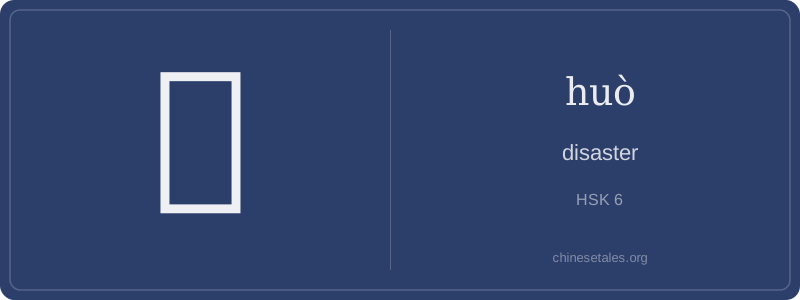
The earliest form of 祸 appears on Western Zhou bronze inscriptions as a compound pictograph: at top, a simplified altar (the precursor to 礻, the ‘spirit’ radical); below, a kneeling figure with arms bound — sometimes with a weapon or blade hovering nearby. This wasn’t just ‘bad luck’; it was ritual punishment — divine retribution for violating sacred oaths or ancestral taboos. Over centuries, the kneeling figure morphed into the right-hand component of modern 祸: the ‘guo’ part (呙), which originally depicted a twisted neck or distorted face, evoking shame and ruin. The altar radical (礻) stayed firmly rooted on the left, anchoring the character’s spiritual gravity.
By the Warring States period, 祸 had shifted from literal sacrificial punishment to metaphorical moral downfall — Mencius uses it to describe rulers who lose the Mandate of Heaven through cruelty. In the *Zuo Zhuan*, it appears in prophecies: ‘bù xiū dé ér wàng xíng, huò jiāng zhì yǐ!’ (‘If virtue is not cultivated and conduct forgotten, disaster will surely arrive!’). Visually, the 11 strokes tell a story: the 4-stroke 礻 (altar) + 7-stroke 呙 (distorted fate) = a perfect visual metaphor: when human conduct strays from the sacred, the self becomes unrecognizable — and ruin follows.
At its heart, 祸 (huò) isn’t just ‘disaster’ — it’s *human-made calamity*: the kind that arises from moral failure, recklessness, or hubris. Think not earthquakes, but broken alliances; not floods, but a slanderous rumor that ruins a career. That’s why it almost always appears in abstract, cause-and-effect contexts — never as a standalone noun like ‘a disaster occurred,’ but embedded in phrases like 自取其祸 (zì qǔ qí huò, ‘to bring disaster upon oneself’) or 招祸 (zhāo huò, ‘to invite trouble’). You’ll rarely see 祸 alone — it’s a team player, usually paired with verbs of causation or nouns of origin.
Grammatically, it functions exclusively as a noun, but one that resists pluralization or quantification (no ‘two disasters’ — you’d use 灾难 instead). Learners often misplace it after verbs like ‘have’ or ‘get’ (e.g., בwǒ yǒu huò’), but native speakers say ‘zāo huò’ (suffer disaster) or ‘yǐn huò’ (invite disaster). It also rarely takes measure words — you wouldn’t say ‘yī gè huò’, but ‘yī chǎng huò’ (a *scene* of disaster) only in highly literary or historical registers.
Culturally, 祸 carries deep Confucian and Daoist weight: it implies karmic consequence, not random misfortune. The classic phrase 福兮祸所伏 (fú xī huò suǒ fú) — ‘within blessing lies hidden disaster’ — captures this duality perfectly. A common mistake? Confusing it with 灾 (zāi), which denotes natural or impersonal calamity (earthquakes, plagues). Using 祸 for an earthquake sounds oddly accusatory — like blaming heaven’s moral judgment!